
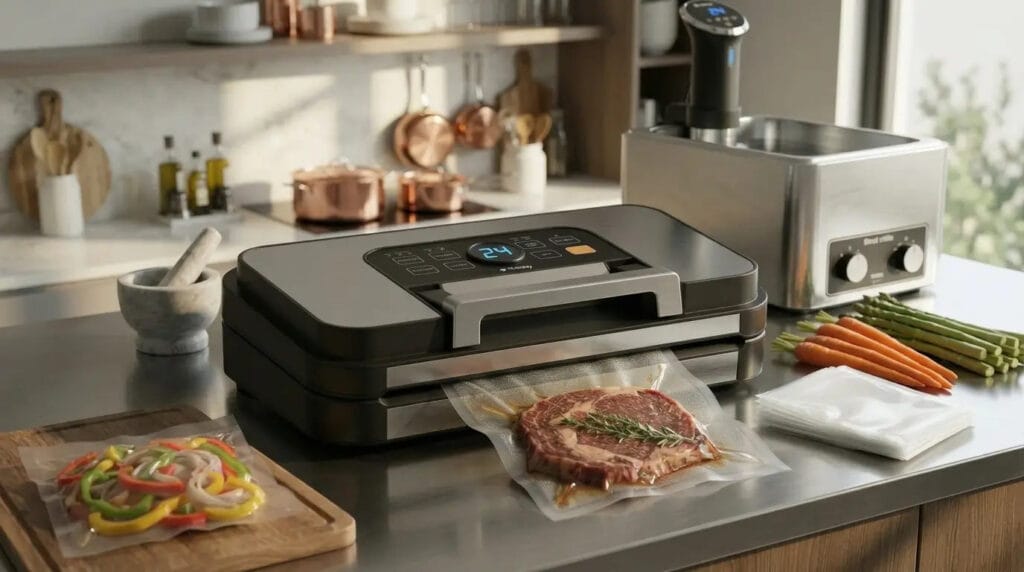
Theresous vide cooking in an immersion heateris one of the most reliable methods for obtaining a stable temperature, even cooking and true consistency from one service to the next. Provided you adjust the water correctly, choose the right container and combine the immersion heater with a clean vacuum system, you gain precision without making your cooking more complex.
In practice, this method is suitable for both demanding domestic use and small regular production. The key point is not just the device, but the wholetemperature + water circulation + packaging + duration.
How to successfully cook sous vide with an immersion heater from the start?
To succeed, you must first stabilize the cooking before even immersing the bags. An efficient immersion heater heats quickly, maintains the temperature without drift and circulates the water evenly around the food.
The safest method involves four simple steps:
- preheat the water to the correct target temperature;
- package the food in a well-sealed bag, without unnecessary residual air;
- avoid overloading the tank to let the water circulate;
- respect a duration consistent with the thickness of the product, not just its weight.
If you are new to this material, you can also read our articleImmersion heater: what is it really used for in sous vide cooking?to lay the foundations before refining your settings.

1000W immersion heater (Accuracy 0.1°C)
- Rapid temperature rise for everyday cooking
- Useful fine precision on meat, fish and eggs
- Easy to use format for a first reliable vacuum station
What settings really make a difference during cooking?
The reader mainly wants to know what parameters to monitor. The short answer is simple:temperature takes precedence over everything, then come the water circulation and the quality of the conditioning.
Temperature
Sous vide cooking with an immersion heater relies on gentle and perfectly controlled heat. A minimal variation can remain tolerable, but poorly mixed water or an undersized device quickly creates gaps between the center and the periphery of the bath.
Water volume
A small bin works great for limited portions. As soon as you increase the number of bags or the size of the pieces, a more stable volume becomes more comfortable and consistent.
Vacuum and weld quality
A poorly closed bag not only spoils the result: it can disrupt the entire cooking process. If water enters, if the bag floats or if air remains trapped, thermal transmission becomes less homogeneous and the final texture suffers.
Immersion heater alone or integrated sous vide cooker: what to choose?
The right answer depends mainly on your pace of use. A single immersion heater is more flexible and often more economical. An integrated cooker is easier to install, more compact and more reassuring if you want a ready-to-use solution.
| Criteria | Immersion heater | Integrated sous vide cooker |
|---|---|---|
| Flexibility | Very good: you choose the tank according to the volume to be processed | No longer limited by the fixed capacity of the tank |
| Clutter | Low out of use | More compact as a dedicated station, but less modular |
| Moving upmarket | Easy: just change the bin or device | More structured, suitable for controlled use |
| Comfort of use | Very good if you are already used to sous vide | Excellent for a simple and quick post to launch |
Verdict:if you are looking for versatility, theimmersion heaterremains the best entry point. If you want a stable, clean and immediately operational station, aintegrated sous vide cookerquickly becomes more comfortable.

Professional GN Sous Vide Cooker – Combisteel
- Dedicated tank more comfortable for repeated cooking
- GN format relevant to structuring a real production station
- More stable solution when volume and cadence increase
When does this method really become interesting in cooking?
Sous vide cooking with an immersion heater becomes particularly interesting when you are looking for arepeatable texture, fewer losses and better organization. This is the case for thick meats, delicate fish, certain low temperature cooking and preparations that need to be anticipated.
It also provides real comfort if you work in sequences: preparation, gentle cooking, cooling, then finishing at the minute. To expand this organizational logic, ourguide to starting sous-vide cooking at low temperaturecomplements this method centered on the immersion heater very well.
In practice, this approach is especially profitable when you want:
- keep a more precise cooking core;
- reduce the gaps between two services;
- prepare in advance without sacrificing final quality;
- better promote sensitive or expensive parts.
Do you want to set up a consistent sous vide cooking station?
Discover our selection of cookers and immersion heaters to choose equipment adapted to your pace and your level of requirements.
FAQs on sous vide cooking with an immersion heater
Is an immersion heater enough to start sous vide cooking?
Yes, if combined with a suitable container and clean vacuum packaging. This is often the most flexible solution for getting started seriously.
Do you absolutely need a vacuum machine to use an immersion heater?
For a regular and safe result, yes. Good conditioning improves thermal transmission and limits texture defects.
What is the most common mistake with an immersion heater?
Overfill the bin or allow the bags to float. The water then circulates less well and the cooking becomes less uniform.
Immersion heater or integrated cooker: which is more profitable?
The immersion heater is often more cost-effective initially. The integrated cooker becomes more interesting when speed, comfort and stability take precedence.


