

You've probably already eaten perfectly evenly cooked meat, pink from edge to edge, with no dry spots or missed core. This is exactly the promise of thesous-vide cooking at low temperature: gain in precision, regularity and tenderness.
Long reserved for professional kitchens, this method is now accessible at home. And contrary to popular belief, getting started does not require complicated installation: you must above all understandthe principle, to usethe right materialand follow a few simple guidelines.
The principle: cook at the exact temperature, not “about”
Traditional cooking heats the outside very much so that the heat then penetrates towards the center. It is effective, but often imprecise: the heart is barely ready when the exterior is already overcooked.
Sous-vide cooking completely changes this logic. The food is packaged in an airtight bag, then immersed in a water bath maintained at aperfectly controlled temperature. If you aim for 54°C at heart for rare beef, the water remains at 54°C: cooking becomes much more regular and much more reproducible.
To remember:sous-vide cooking does not seek power, but precision. It is this stability that makes the difference in the final texture.
The essential equipment to get started
To get started, you need three elements: a vacuum machine, an immersion heater and a suitable container. The rest comes next.
1. The vacuum machine
It is used to remove air from the bag before cooking. This is the basis for ensuring good thermal contact around the food and preventing it from floating or cooking unevenly. For beginner use, an external suction machine is more than sufficient.
If you are unsure about the type of bags to use with this type of machine, our articleEmbossed or smooth bags: which bag for your vacuum machine?completes this point well.
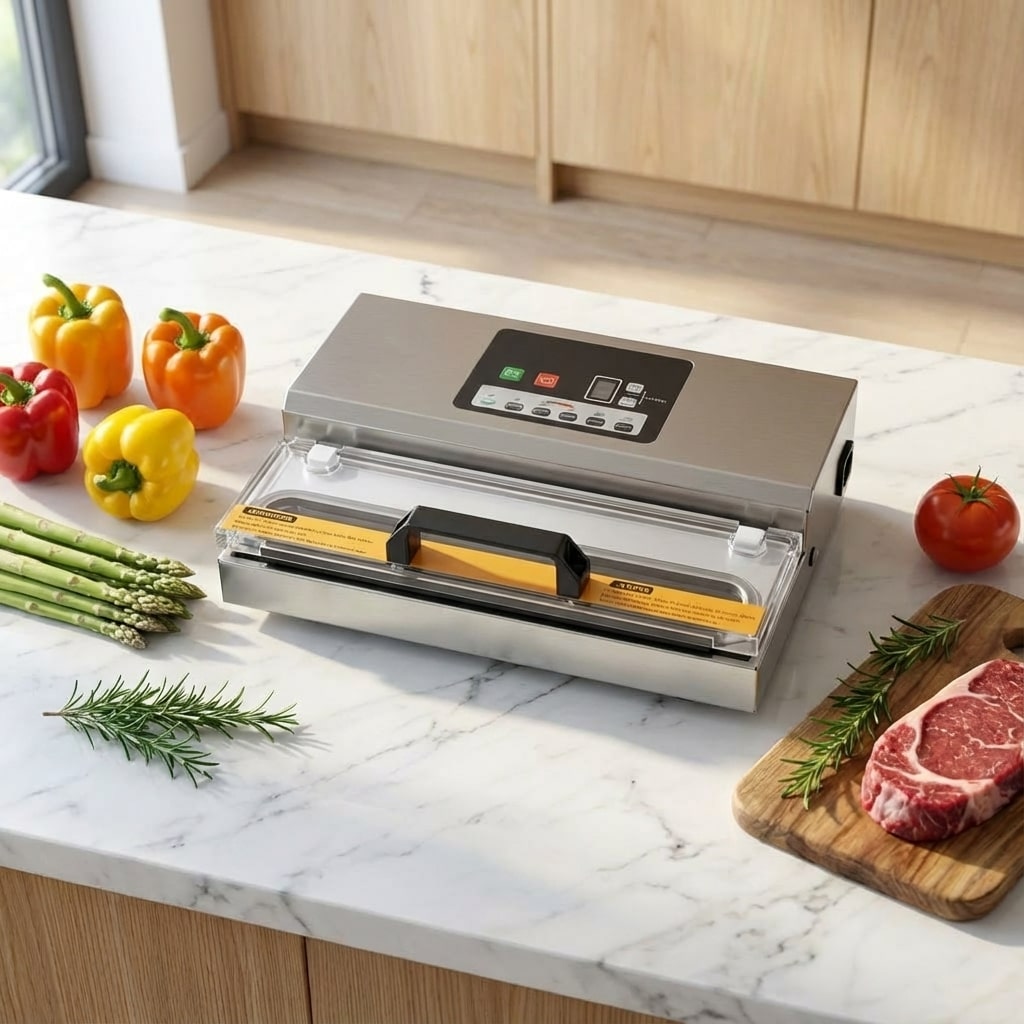
- Dual-pump system reaching -0.96 bar for a powerful vacuum that better protects food from freezer burn and oxidation
- Mode Pulse makes it easy to control the vacuum level for delicate foods without crushing them
- Compact, powerful 31 cm model that is easy to integrate into a workstation
2. The immersion heater
The immersion heater, also called a “sous-vide stick”, heats the water and circulates it to maintain a uniform temperature throughout the bath. It is he who transforms a simple saucepan or a tray into a precision cooking tool.
If you want to delve deeper into its exact role, the articleImmersion heater: what is it really used for in sous vide cooking?is directly relevant.
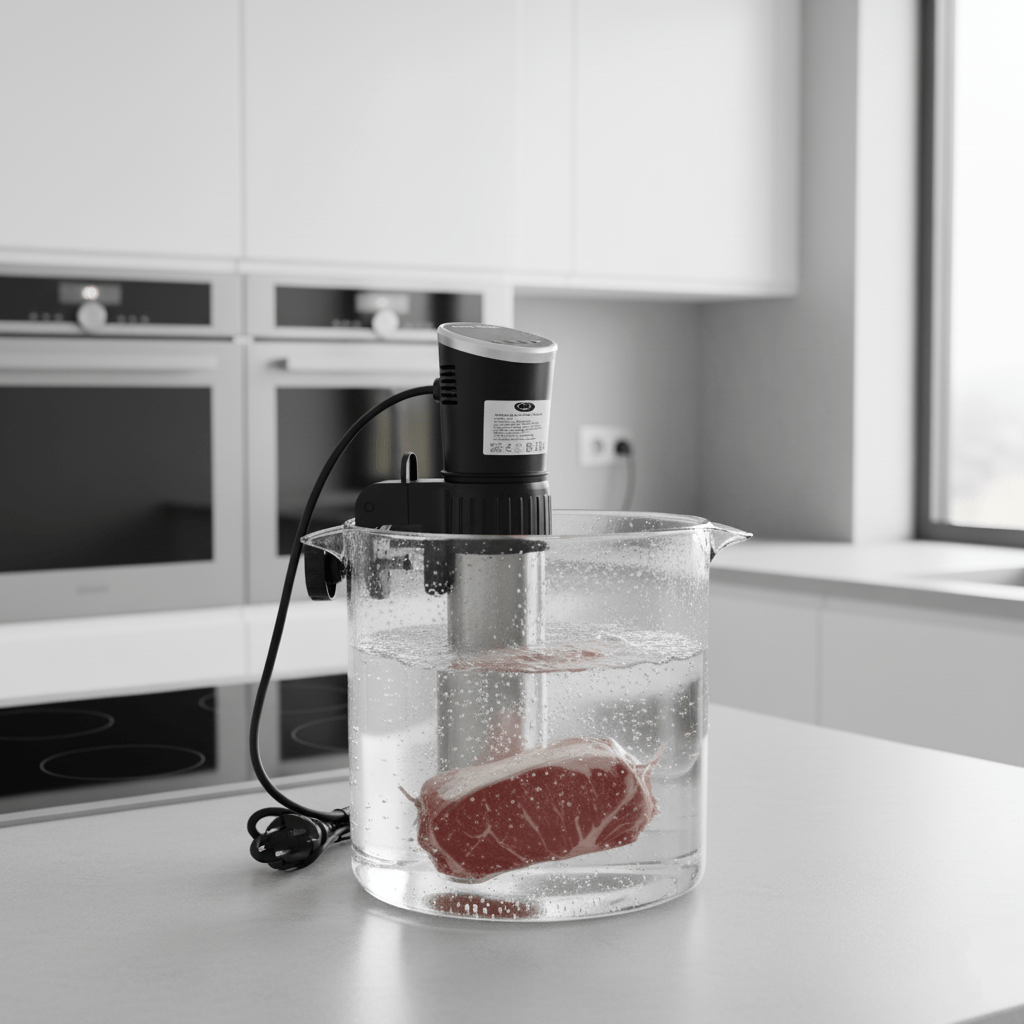
- Stable temperature within a tenth of a degree
- Suitable for both short and long cooking
- Transforms a simple container into a controlled bath
3. The tray or pan
To start, a large saucepan may be enough. But as soon as cooking continues, a polycarbonate tray with a lid or anti-evaporation system becomes more comfortable. This limits water loss and better stabilizes the whole.
Which foods are suitable for sous-vide cooking?
Sous-vide cooking is particularly interesting for foods where precision really changes the result:
- red meats, for uniform cooking;
- the fish, for a more delicate texture;
- poultry, to keep it soft;
- some long preparations, like confit pork.
It is less there to “do it faster” than tobetter control the result.
A few simple tips to get started
Here are some temperatures and times often used for practicing:
| Preparation | Temperature | Indicative time |
|---|---|---|
| Perfect egg | 64°C | 45 mins |
| Salmon steak | 50°C | 20 mins |
| Beef fillet | 54°C | 1h30 |
| Pork belly | 65°C | 24h |
These figures remain starting points. The thickness of the product, its quality and the desired result may justify some adjustments.
Don't forget the finish
When taken out of the bag, cooking is successful, but the appearance may appear pale. It's normal. For meat in particular, a quick finish in a very hot pan allows you to create the crust and the Maillard aromas without breaking the precision work done in the bath.
The good reflex: dry the surface well, sear very quickly, then serve immediately.
The tip that changes everything:the finish should be short and intense. If you cook for too long, you cancel out part of the benefit of low temperature cooking.
Why this method appeals so much to motivated beginners
Sous-vide cooking is reassuring because it makes the results more predictable. Once you understand the right basics, delicate cooking is less easy to fail. It’s also a practical method for getting organized, preparing in advance and serving with more regularity.
If you want to explore the whole world of dedicated hardware, you can then browse our collectionsous vide cooking.
Ready to do your first low temperature cooking?
Find the essential equipment to get started simply and obtain consistent results from the first attempts.
See the vacuum equipmentFAQ for starting sous-vide cooking
Do you need a vacuum machine to get started?
Yes, if you want clean and consistent sous-vide cooking. You must be able to properly package the food before immersion in the bath.
What exactly is the immersion heater used for?
It heats and circulates the water to maintain a stable and even temperature throughout cooking.
Is sous-vide cooking complicated for a beginner?
No. Once the principle is understood, it is often easier to master than traditional delicate cooking, because the temperature is precisely controlled.
Why should you sear meat after cooking?
Because the sous-vide bath cooks the interior perfectly, but does not create the crust or grilled aromas. A quick finish over high heat completes the result.