
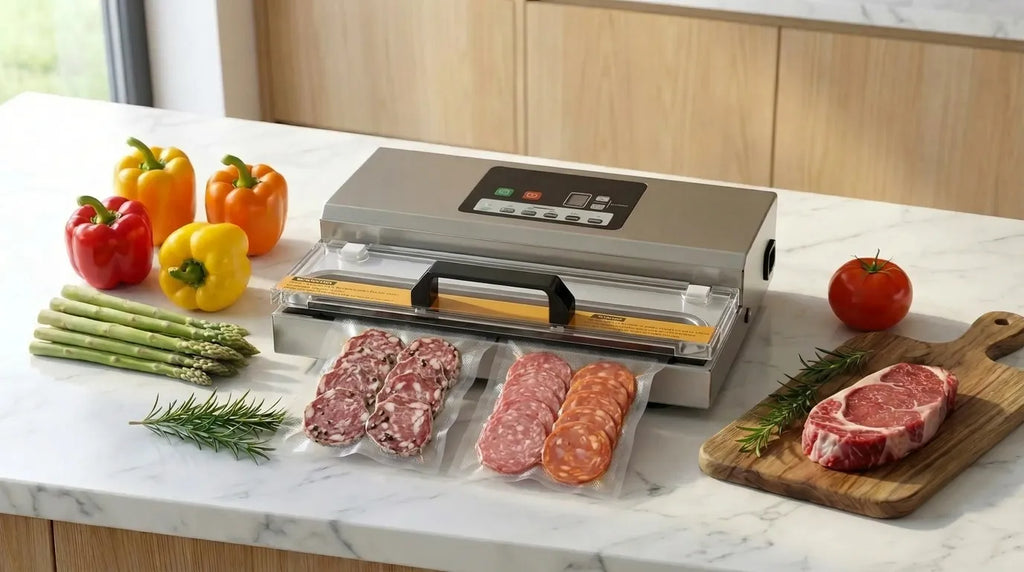
Therecold cutsoften reacts very well to sous vide, but not always for the same reasons. With a ham chiffonade, the objective is above all to avoid drying out and oxidation. On a dry sausage, we tend to try tofreeze the texture at the right time. On dried meat, vacuuming helps stabilize the piece after curing. And on a fragile product like blood sausage, it is especially important to avoid crushing.
In other words, choose avacuum machine for cold cuts, it’s not choosing “the most powerful”. It’s choosing the machine suited toproducts you really pack: thinly sliced, whole piece, fatty, dry or fragile product.
Why do charcuterie benefit so much from sous vide?
Sous vide helps on several very concrete points:
- limit oxidationfats and surface;
- slow down dryingsliced products;
- better stabilizecertain dried cold meats;
- better protected in the freezerif necessary;
- portion neatlyfor the home as well as for sale.
But not all products require the same machine or the same method. This is what makes this article useful: starting from real uses, not from an overly generic discourse.
The right reflex:on charcuterie, vacuum sealing serves as much to protect the texture as to prolong the shelf life.
1. For the home: an external machine with Pulse mode is often sufficient
For a domestic kitchen, a goodexternal suction machinealready covers a large part of the needs: sliced ham, rosette, terrines, opened sausage, pre-preserved portions in the fridge or freezer.
The really useful point here is thePulse modeor manual. It allows you to stop the suction before crushing:
- a chiffonade;
- a fragile sausage;
- a soft or very fatty product.

- Very suitable for ham, rosette and homemade portions
- Pulse mode useful for thin or fragile products
- Good compromise between simplicity and efficiency
2. For more sustained use: the pro butcher type machine
As soon as we switch to charcuterie, butcher or caterer use, the pace changes. You need a machine that connects cycles, supports wider bags, and maintains a clean seal even when a little grease or humidity complicates the work.
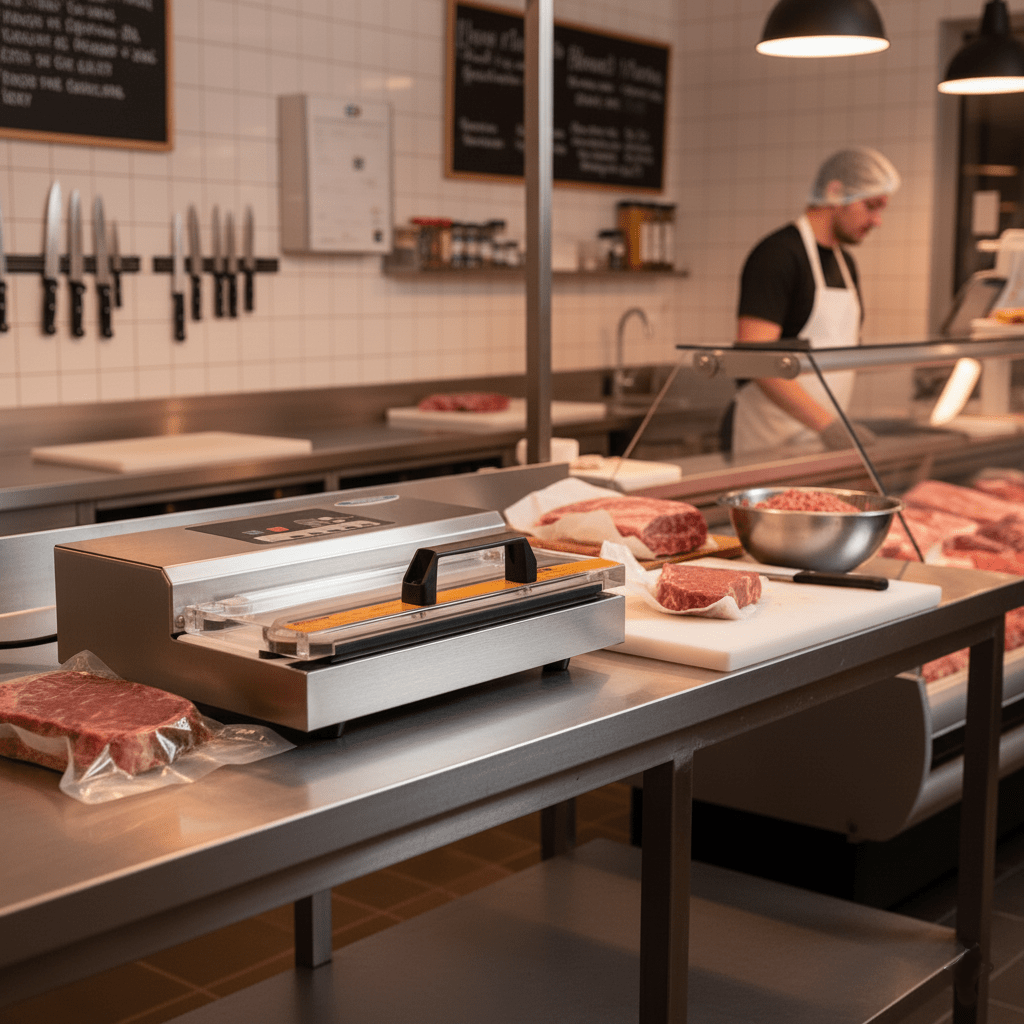
- More suitable for regular use and higher volumes
- Good sealing on fatty cold meats or whole pieces
- Logical solution for commerce and laboravousre
This type of machine becomes particularly relevant when you need to work quickly, cleanly, and on regular batches.
3. Not all charcuterie products keep the same
Talking about “charcuterie” as a single block is an error. A vacuum machine is not used in the same way depending on the product:
| Product | Main issue | Point of attention |
|---|---|---|
| Sliced ham / chiffonade | Avoid drying out | Do not crush the slices |
| Dry sausage | Stabilize the texture | Prevent it from continuing to harden |
| Dried meat | Store after refining | Do not let it continue to dry too quickly |
| Boudin / fragile products | Protect without distorting | Use gentle suction |
And for the most fragile cold meats?
Certain cold cuts deserve special attention, especially those that deform easily or have a very soft texture. This is the case with black pudding, for example, where the question is not only preservation but also the pressure applied during packaging.
On this precise angle, the most complementary article isVacuum storage of black pudding.
In short:for charcuterie, the best machine is the one that protects the right product in the right way — not necessarily the one that creates the most brutal vacuum.
How long can cold meats be kept vacuum-packed?
Times vary greatly depending on the product. Here are reasonable benchmarks:
| Type of cold meats | In the fridge without vacuum | In the refrigerator under vacuum | In the vacuum freezer |
|---|---|---|---|
| Sliced cold cuts | 2 to 4 days | 5 to 10 days | A few months |
| Whole piece dry | Varies depending on product | Weeks to a few months | Several months |
| Fragile or cooked product | A few days | A few days better | A few weeks to months depending on product |
I have deliberately tightened the figures: for charcuterie, the texture and type of product are too important to promise durations that are too broad without nuance.
What type of bags to use?
For machines with external suction, theembossed rolls 30 cmremain a very practical solution, especially for long products such as a whole sausage or a piece of dried meat. They allow you to cut the useful length to the right format, without wasting too much material.
Conclusion: a vacuum machine for charcuterie must above all be adapted to the product
The right choice depends less on the word “charcuterie” and more on the specific product you are packaging. For sliced ham and home use, an external machine with Pulse is often sufficient. For more regular and larger work, a professional machine becomes logical. And for the rest, the real gain comes mainly from intelligent networking between the articles in the sub-cluster.
If you mainly work with sausage or dried meat, it is precisely these specialized pages that will provide the most precision.
Need a vacuum machine suitable for cold cuts?
Discover our selection of vacuum machines for sliced ham, sausage, dried products and fragile cold meats.
See all machinesFAQs about the vacuum sealer for cold cuts
Is a standard machine enough for charcuterie at home?
Yes, very often. A good external machine with Pulse mode already covers the majority of domestic needs.
Why is Pulse mode useful on cold cuts?
Because it helps avoid crushing thin slices, soft products or certain fragile cold meats.
Which article should I read if I am mainly interested in sausage?
The most relevant article isVacuum-packed sausage: conservation guide.
What if I make homemade jerky?
So you have to readVacuum dried meat, which deals specifically with vacuum salting and conservation after drying.