
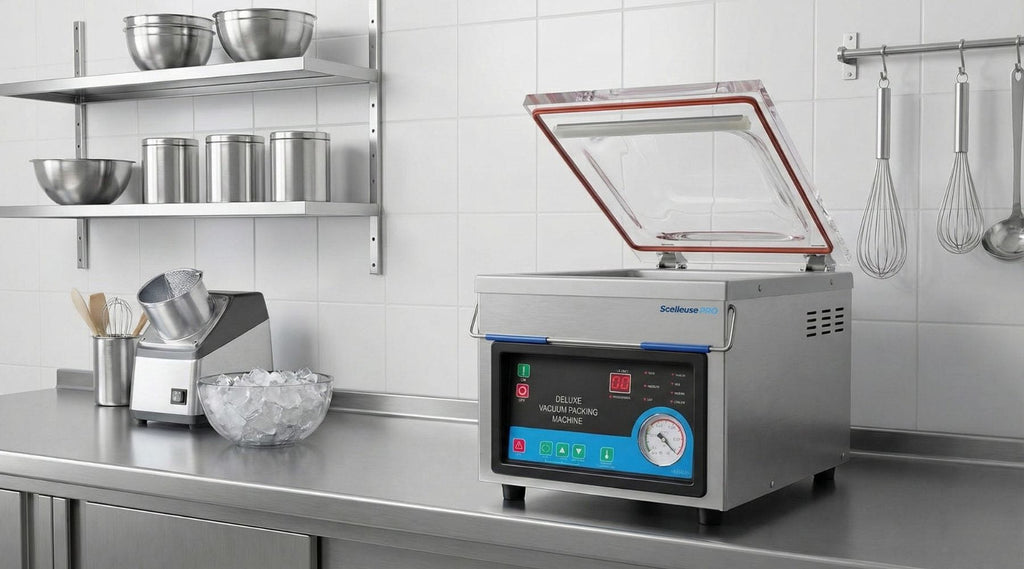
When we talk aboutindustrial vacuum machine, it is not enough to look for “the most powerful”. The right choice depends mainly on yourcadence, from theproduct size, whether or not you need to processliquids, and the level of performance expected on a daily basis.
Between a small table bell machine, a standard laboratory model and a double production bell, the difference is not only a question of price: it is a question of actual use. Here's how to choose the right machine without making the wrong category.
The first real criterion: bell or external aspiration?
For most industrial or intensive uses, thebell machineremains the reference. It makes it possible to achieve a higher vacuum, to work more cleanly and above all to manage wet or liquid products without pumping the preparation back into the pump.
| Technology | Main asset | Main limit |
|---|---|---|
| Bell machine | High vacuum, liquids possible, consistent professional use | Heavier and more expensive to purchase |
| External suction | Less bulky, often more affordable | Less suitable for liquids and very intensive uses |
If you want to explore this logic of choice in more depth, the articleChamber vacuum machine: the professional buying guidecompletes this topic perfectly.
Simple rule:if you package sauces, marinades, wet preparations or sensitive products, the bell quickly becomes the right choice. The external remains especially relevant when you work with dry products and want to limit the size.
How to choose an industrial vacuum machine?
Before comparing the models, we must look at four concrete criteria:
- technology: bell or external;
- pump power: expressed in m³/h, it influences the cycle speed;
- weld length: it determines the useful width of the bags;
- the machine format: table model, mobile on wheels, or double production bell.
A consistent purchase is about choosing the right machine for its actual flow, not overpaying for capacity that will remain underutilized.
1. The compact tabletop: to get started cleanly
A small tabletop bell machine is very suitable for a laboratory just starting out, for a demanding kitchen with little space or for a regular but not massive need. It already allows you to work seriously without immediately switching to a very heavy machine.

- 10 m³/h pump for regular use
- Welding 26 cm
- Good solution for small portions and wet products
2. The versatile standard: the best balance zone
For many professionals, the real balance point is here. A standard chamber machine can cover the majority of needs in catering, breweries, butchers or preparation workshops without switching to a heavy production machine.

- Format very suitable for standard needs
- Wide weld 8 mm
- Digital control and simple maintenance
3. Large mobile capacity: for large volume
As soon as the parts get bigger, the volumes increase or the machine must keep up a sustained pace, a model on wheels becomes much more coherent. We gain in chamber depth, useful width and cadence.

- Pump 20 m³/h
- Welding 40 cm
- Good solution for laboratory, butchery and large volume
4. The double bell: to eliminate downtime
The double bell meets a very specific need: to produce a lot, continuously. While one chamber is working, the other is being recharged. This type of machine takes on its full meaning when productivity becomes the number one criterion.

- 4 sealing bars of 60 cm
- Double pump 2 x 20 m³/h
- Designed for mass production
5. The professional external alternative: useful in certain cases
A professional external suction machine can remain relevant if you mainly work with dry products, without liquids, and want a good level of performance with a more limited footprint. It's not the best universal choice, but it's not to be ruled out either.

- Good speed and counter format
- Less bulky than a bell
- To be reserved for uses without liquids
The technical criteria that really change the result
| Criteria | Why it is important |
|---|---|
| Pump (m³/h) | Determines cycle speed and ability to maintain cadence |
| Sealing bar | Conditions bag width and packaging versatility |
| Room size | Essential for bulky or thick products |
| Mobility | Important if the machine must move for cleaning or workshop organization |
If you want to complete the reflection from the budget angle, the articlePrice of a professional vacuum machine: the real budget depending on your activityis the most logical to consult next.
So, which industrial vacuum machine should you choose?
To summarize:
- small volume but professional need: compact with bell;
- daily multi-use: standard bell model;
- high flow: mobile version on wheels;
- continuous production: double bell;
- dry products with space constraints: external professional possible.
The right purchase is not the most impressive machine, but the one that best suits your actual volume, your formats and your production pace.
Need to equip your workshop or professional kitchen?
Discover our range of professional vacuum machines to choose a model adapted to your speed, your products and your budget.
See the entire Pro rangeFAQs about industrial vacuum machines
Does an industrial vacuum machine necessarily have to be a bell type?
Not necessarily, but in the majority of intensive uses or with liquids, the bell remains the most consistent and versatile solution.
What pump power should you aim for?
It all depends on the daily volume. As the cadence increases, a powerful pump becomes more important to keep cycles fast and regular.
When should you switch to a wheeled machine?
As soon as volumes become large, the products are larger or the machine must undergo continuous sustained use.
Is the double bell useful for all professionals?
No. It takes on its full meaning when maximum productivity and reduction of downtime are priorities. For many activities, a good standard bell is more than sufficient.