
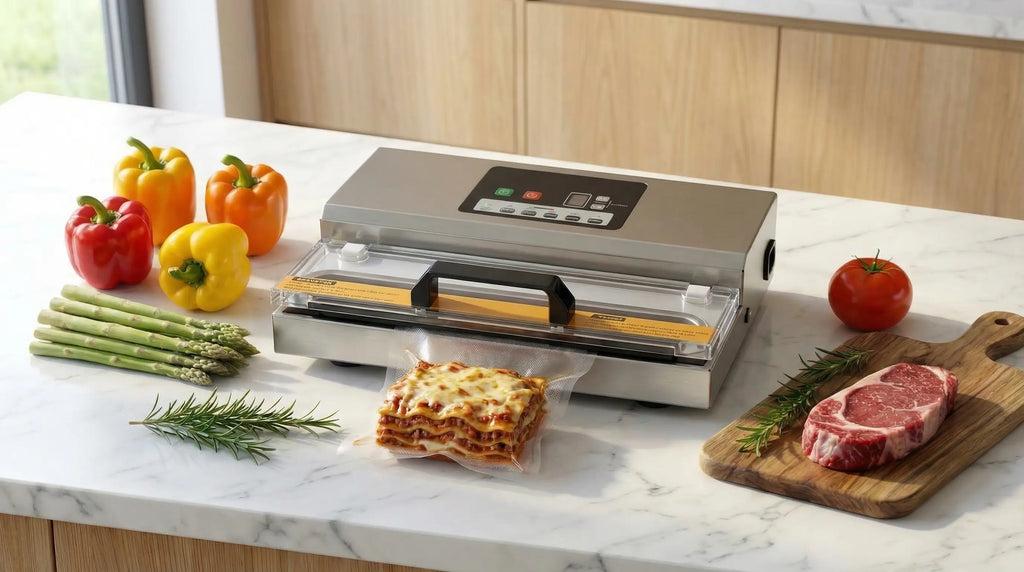
A vacuum machine seems simple from the outside: you put food in a bag, you press a button, and the bag sticks around the product. But in reality, she realizestwo very specific actions:remove the air, Thenseal hermeticallythe bag.
Understanding how this works helps you to better choose your equipment, to avoid bag errors, and above all to know why some machines handle liquids... and others not. Here, the objective is not to redo a big buying guide, but to explainthe real principle of vacuuming.

- Good basis for understanding suction + welding on a daily basis
- Dual pump and Pulse mode
- Compact format for regular home use
The basic principle: remove oxygen
Air is one of the great enemies of conservation. It promotes oxidation, drying, certain taste changes, and accelerates the visual deterioration of many foods.
A vacuum machine therefore does not directly “preserve” food by magic: itreduces air around the product, then sheprevents his returnthanks to waterproof welding.
The complete principle consists of two steps:
- the aspiration: the machine removes the air from the bag or the chamber;
- welding: it closes the bag to maintain this vacuum level.
To remember:a vacuum machine does not need to be complicated to be effective. What matters is the quality of the suction, the regularity of the seal and the suitability for the type of food packaged.
Step 1: how is the suction done?
When the cycle starts, apumpturns on to remove air. On an external machine, this air is sucked directly through the opening of the bag. On a chamber machine, the entire chamber is placed under vacuum.
As the air escapes, the pressure drops and the bag gradually presses against the food. This is what we see the most: the bag becomes a sort of second skin around the product.
The vacuum level then depends:
- the quality of the pump;
- the type of machine;
- the nature of the packaged product;
- the quality of the bag used.
Depending on the machines, a more or less high vacuum level is reached. But in all cases, the goal remains the same:remove as much air as possible without damaging the food.
Step 2: How is the soldering done?
Once the suction is complete, the machine activates itswelding bar. A heating resistor briefly melts the two layers of the bag to fuse them. When the heating stops, the solder cools and the bag remains closed.
This is a crucial step. Correct vacuuming with poor soldering gives a poor result. If air re-enters, the vacuum interest disappears almost immediately.
A good machine must therefore be judged on two points at the same time:
- the quality of the vacuum;
- reliability of the weld.
Why do certain foods require more precautions?
Not all products react the same way. A firm piece of meat, cheese, dry pasta or fish does not face the same constraints as a fragile, moist or liquid food.
This is why some machines offer:
- APulse modeto manually control suction;
- Asolder only mode;
- accessories forboxes or jars.
The basic operation does not change, but the way of applying it varies depending on the product.
What is the difference between external machine and bell machine?
This is the point that creates the most confusion. Both machines vacuum and weld, but they don't do it the same way.
| Machine type | How it works | Practical consequence |
|---|---|---|
| Exterior suction machine | It sucks air through the opening of the bag | Very good for solid products; less suitable for liquids |
| Bell machine | It clears the whole room | Allows you to better manage sauces, soups and marinades |
To explore each case in more detail, the good complementary articles are:
Thus, this article remains focused on thegeneral principle, without unnecessarily encroaching on specialized guides.
Why does vacuum sealing really help with preservation?
The benefit comes mainly from the reduction in contact with the air. This helps to better protect:
- meat and fish in the refrigerator;
- frozen foods against frost and cold burn;
- dry products against ambient humidity;
- portions prepared in advance with organizational logic.
Sous vide does not replace cold or hygiene, but it clearly improves conservation when used correctly.
Important :sous vide does not mean “out of the fridge”. For fresh foods, the cold chain remains essential.
What a sous vide machine doesn't do
To fully understand how it works, you also need to know what it doesn’t do:
- it does not sterilize food;
- it does not replace the refrigerator or freezer;
- it does not correct a bad choice of bag;
- it does not handle liquids well if the technology is not suitable.
It is often by forgetting these limits that we find ourselves disappointed with the result.
In summary: how does a vacuum machine work?
The mechanism is simple: a pump removes the air, then a sealing bar closes the bag. The entire performance of the machine then depends on the quality of these two operations and on the suitability for the type of food packaged.
If you just want to remember the essentials:the external machine sucks through the opening of the bag; the bell machine vacuums the entire room. It is this difference that explains most real uses.
Want to move from theory to practice?
Discover our vacuum machines to understand concretely how vacuum, welding and different uses work.
View vacuum machinesFAQs on how a vacuum machine works
What is the main role of a vacuum machine?
Its role is to remove the air around the food then to hermetically seal the bag to slow down oxidation and improve conservation.
Why is welding as important as vacuuming?
Because good suction without reliable sealing is not useful for long. If the air returns, the benefit of the vacuum disappears.
What is the difference between an external machine and a bell machine?
The external machine sucks through the opening of the bag, while the bell machine vacuums the entire chamber. This especially changes the management of liquids.
Is a vacuum machine enough to preserve food without cold?
No. Sous vide improves preservation, but it does not replace either the refrigerator or the freezer for fresh products.