
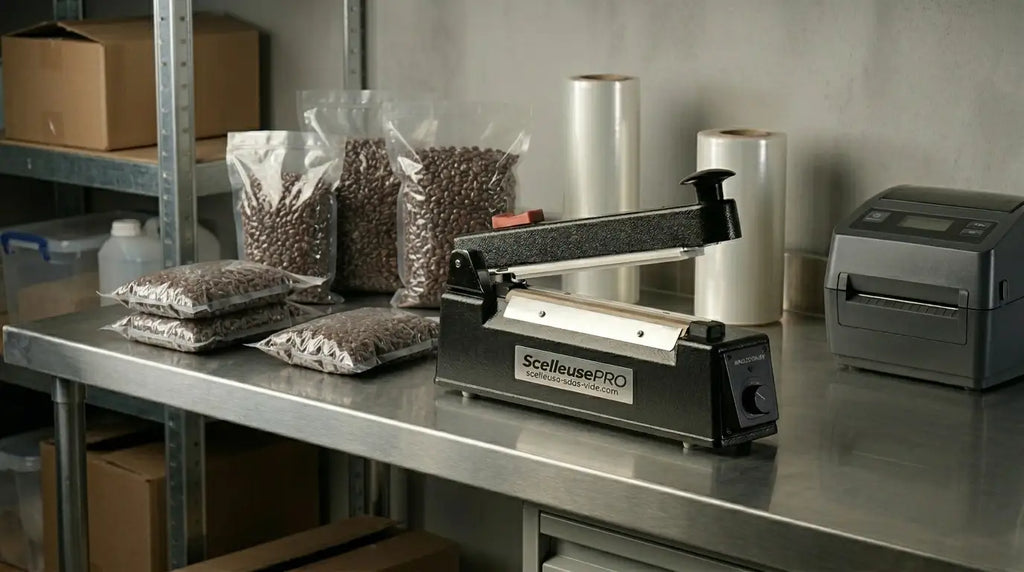
Amanual plastic welderis the right choice when you need to close bags cleanly, quickly, and without investing in a heavier machine. It is very suitable for small and medium volumes, provided you choose the right seal length, the right type of film and a realistic work pace.
In practice, it is especially interesting for PE, PP or thin complex bags, consumables, dry preparations and all uses where a clean seal is sought without necessarily using complete vacuum.
When is a manual plastic welder really enough?
The real question is simple, do you even needclosea sachet, or do you also need to manage high throughput, thick films or continuous throughput? If your need remains occasional or regular, a manual impulse welder often does the job with an excellent simplicity-effectiveness ratio.
It only heats when pressed, which limits consumption and reduces the risk of permanent heating. This is precisely what makes it practical for the workshop, food preparation, shipping small batches or packaging parts.
- You close bags one by one, without a continuous chain.
- You use standard formats and films that are not too thick.
- You are looking for a clean, quick and easy to repeat weld.
- You want a compact station, easy to use and not restrictive.

- Compact format, very easy to place on a work surface.
- Impulse suitable for everyday fine to medium plastic bags.
- Quick handling to close cleanly without a bulky machine.
How to avoid poor sealing on a plastic bag?
The short answer is that the quality of closure depends less on marketing discourse than on three very concrete points,the right material, the right pulse time and even pressure. Bad welding often comes from a poorly adapted film or a movement that is too rapid.
In the field, the most common mistake is wanting to weld everything with the same setting. A thin bag melts if the pulse is too long, while a denser bag seals poorly if the pulse is too short. You must therefore calibrate the machine on your real film, not on a theory.
Pro tip:Always do two or three tests at the start of a batch. If the solder whitens, warps, or opens when pulled lightly, the setting or film is not yet good.
If you need to further secure your closures, you can also read our article onthe reliable food heat sealer, useful when the requirement for regularity goes up a notch.
Points to check before validating your equipment
Here are the most useful checks before purchasing, because they avoid the majority of disappointments:
- Bar length, so as not to be blocked by the width of the bags.
- Plastic type, because not all films react to impulse in the same way.
- Actual cadence, especially if several operators use the station.
- Job stability, essential to obtain a straight and repeatable weld.
Which solution should you choose depending on your speed and the size of your bags?
The correct answer depends on your volume and packaging size. A manual plastic sealer is excellent for common uses, but it shows its limits when the bags become longer, thicker or more numerous.
| Solution | For what use | Strong point | Limit |
|---|---|---|---|
| Manual plastic welder | Small to medium series, standard bags | Simple, compact, economical | Less suitable for sustained cadences |
| Heat sealing pliers | Larger bags or mobile handling | Good reach, more flexible closure in situation | Less comfortable for long posed series |
| Pedestal heat sealer | Intensive and repetitive use | Cadence, regularity, operator comfort | More bulky and more budget-friendly |
Verdict:if you mainly package standard bags on a simple station, the manual plastic sealer remains the best compromise. If your formats become longer or your pace more intense, it is better to move up a notch before closing defects cause you to lose time.

- Practical format when the closure must remain flexible at the post.
- Interesting useful width for more ambitious bags.
- Very good relay when the small manual welder becomes limited.
When should you upgrade to a more robust model?
The clearest signal is the repetition of defects, micro-openings, irregular welds, operator fatigue or loss of time on adjustments. At that point, the problem is no longer your method, it is often the level of the machine.
If you need to close large bags, sequence series or work on more technical films, a more robust machine quickly becomes profitable. For long seal bars, our article onXXL pulse welderhelps to clearly frame the need.
In other words, the manual plastic welder is an excellent tool as long as it remains within its comfort zone. It’s not a do-it-all machine, but it’s often the most logical answer for closing cleanly without over-equipment.
Need a simple solution to close your bags without wasting time?
Browse our selection of sachet sealers and heat sealers to choose the format suited to your pace and your plastic films.
See the full collectionManual plastic welder FAQ
Does a manual plastic welder vacuum?
No. It closes the bag, but does not suck in air like a vacuum machine.
Which bags can be closed with this type of machine?
Mainly PE, PP or film bags compatible with impulse sealing.
Is it suitable for food use?
Yes, if the bags used are intended for food contact and if the seal is well adjusted.
When should you switch to a standing heat sealer?
As soon as the pace becomes sustained, the bags are large or the regularity must remain impeccable all day long.