
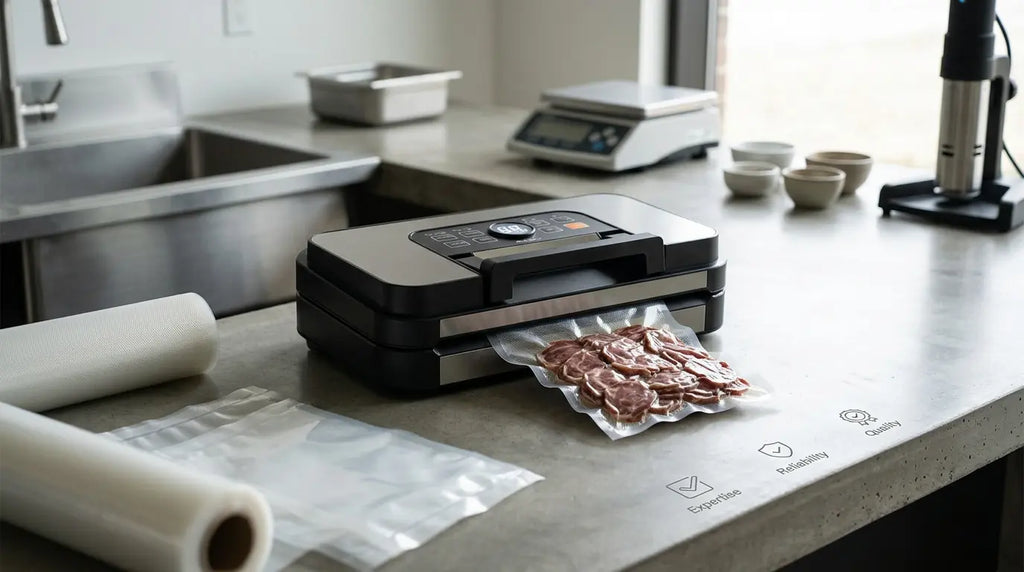
A action vacuum sealer can be tempting if you are looking for a low price, but the Action offer varies and the product sheet is not always accessible online in a usable way. Before buying, especially check the weld width, compatible bags, wet food management and the ability to chain several bags together.
For a one-off trial, a discount offer may be sufficient. To regularly preserve meat, fish, prepared meals or portions to freeze, a more stable machine avoids weak seals and bags to be redone.
What should you check on an Action vacuum sealer?
Start with the data visible on the packaging or the store sheet. If the power, maximum bag width, suction modes or compatible consumables are not clear, the purchase becomes riskier.
Points to check before checking out:
- maximum bag width, ideally close to 28 to 30 cm for versatile use;
- compatibility with embossed bags, essential for external machines;
- wet food mode or gentle setting if you're packing juicy produce;
- rest time between cycles, useful if you prepare several sachets in a row;
- warranty and return, especially on a delivery device.
Without this information, it is better to consider the machine as a test solution, not as a reliable conservation station.
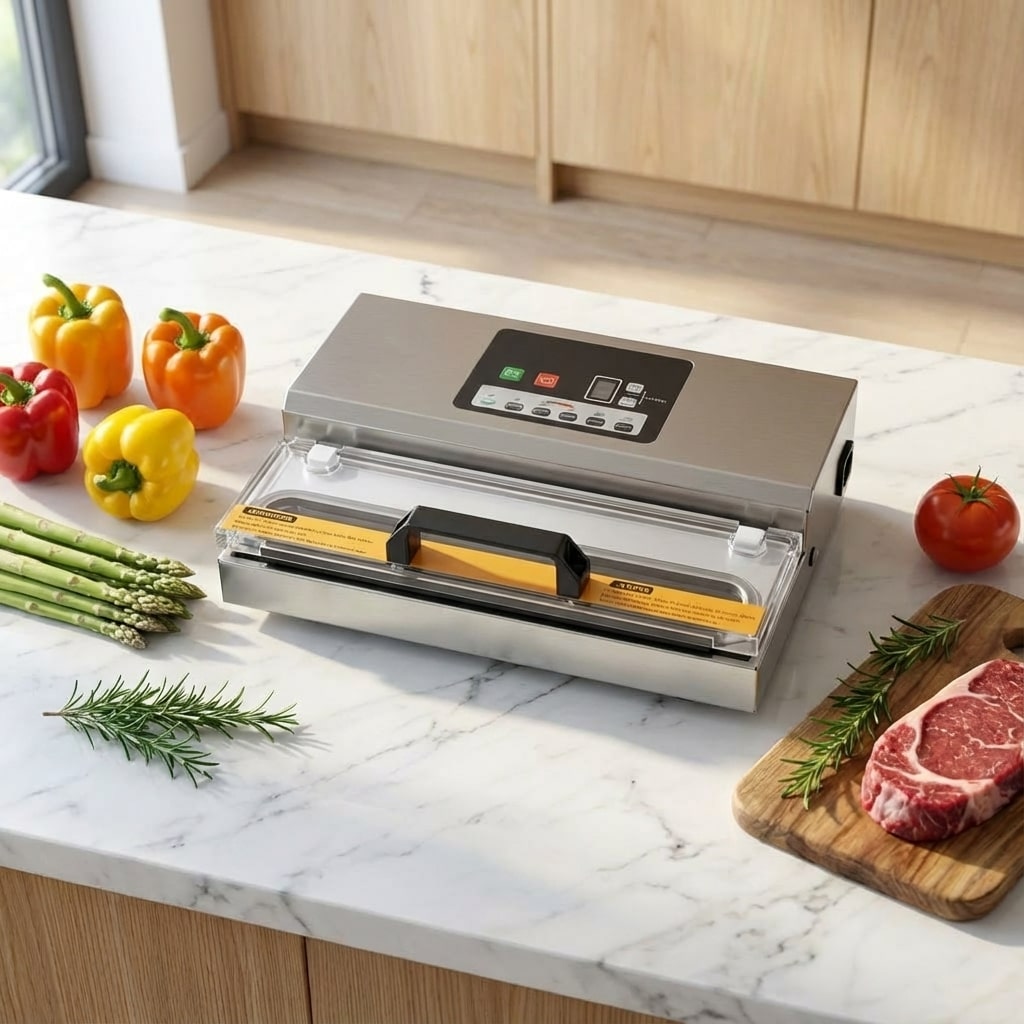
- Dual-pump system reaching -0.96 bar for a powerful vacuum that better protects food from freezer burn and oxidation
- Mode Pulse makes it easy to control the vacuum level for delicate foods without crushing them
- Compact, powerful 31 cm model that is easy to integrate into a workstation
Why can a discount offer quickly show its limits?
Low price is not the problem; the risk comes mainly from the lack of technical margin. An external machine that is too light can vacuum a few dry bags correctly, then become less comfortable as soon as the products are damp, fragile or numerous.
| Location | Discount machine | Better sized machine |
|---|---|---|
| A few dry bags | May be sufficient if the bags are compatible | Superior comfort but not essential |
| Wet foods | Risk of liquid rising and less clean sealing | More reassuring modes and double sealing |
| Repeated sets | Pause time and heating to monitor | More regular cycles, fewer bags to redo |
| Long freezing | More penalizing micro-leaks | More secure closure to avoid frost and oxidation |
Verdict: Action remains relevant for testing sous vide on a low budget. If you package often or if storage in the freezer really matters, choose a machine with more stable suction and more secure sealing.
In what cases is buying from Action consistent?
It is consistent for rare and undemanding use. For example: close a few dry portions, test the vacuum principle or equip a second home without aiming for a regular pace.
On the other hand, avoid basing a real food stock on a machine whose characteristics remain unclear. More demanding uses require reliable sealing, stable suction and easy-to-find bags.
- Yes to test without a big budget.
- Caution for moist or fragile foods.
- Not ideal for series, long freezing and frequent batch cooking.
Which alternative should you choose to avoid unpleasant surprises?
Choose an external machine with double sealing if you want to remain compact without losing safety. This type of model keeps the simplicity of a kitchen machine, while reinforcing the most critical point: the sealing of the bag.
To compare with other offers from major brands, also consult our analysis of the Lidl Silvercrest vacuum sealer. If your priority remains the budget, the guide cheap vacuum sealer helps distinguish real economy from fake good deal.
Need a safer machine than an in-order purchase?
Compare models designed for more regular suction, more reliable sealing and easy-to-find bags.
See suitable vacuum sealersFAQ
Does Action always sell the same vacuum sealer?
No. Offers may vary depending on arrivals, stores and periods.
Which bags to use with an Action vacuum sealer?
An external machine usually requests embossed bags. Smooth bags are reserved for chamber machines.
Is a discount machine enough for wet foods?
It can help, but wet foods require more caution: liquid sucked up, fragile sealing and more frequent breaks.
When to choose a more reliable alternative?
As soon as you make batches, long-term freezing or preparations sensitive to micro-leaks.