
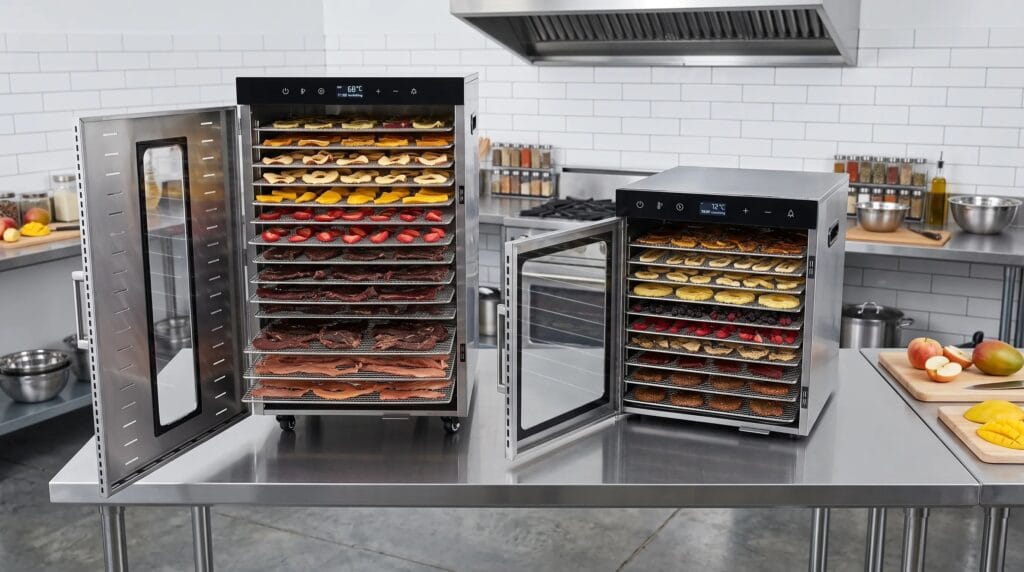
For dehydrate fruit, they must be washed, cut regularly, arranged without overlapping and then dried at a moderate temperature until they no longer contain moisture at the core. The good result comes less from a high temperature than from a slow, regular and well-ventilated drying.
Apples, bananas, strawberries, mangoes, pears, apricots or citrus fruits do not all dry at the same rate. The simple rule: the juicier or thicker the fruit, the longer and more controlled the cycle should be.
How to prepare fruit before dehydrating it?
The preparation determines the regularity of drying. You should aim for clean, thin pieces that are close in size, as fruit that is too thick can appear dry on the outside while retaining moisture in the center.
Start by washing the fruit, remove the damaged parts, then cut them into even slices. For fruits that brown quickly, such as apples, pears or bananas, a slight dip in diluted lemon juice helps limit oxidation without masking the taste.
- Apples and pears: thin and regular slices, with or without skin depending on the desired texture.
- Bananas: washers not too thick to avoid a sticky core.
- Strawberries: halves or slices depending on their size and moisture content.
- Citrus: thin slices, especially if they are intended for infusion or decoration.
Verdict: if the pieces are not regular, the cycle becomes difficult to master. Some fruits will be too dry while others will remain unstable for storage.

Stainless steel dehydrator 10 trays – 800 W, 30 to 90°C
- 10 stainless steel trays for drying several preparations in a single session.
- 800 W power for regular drying of fruits, vegetables, herbs or homemade preparations.
- Adjustable temperature from 30 to 90°C to adapt drying to fragile foods as well as more intensive needs.
At what temperature should you dehydrate fruit?
For most fruits, a moderate temperature is sufficient. In practice, we seek to remove the water without cooking or caramelizing the natural sugars too quickly. A beach around 50 to 60°C suitable for many fruits, with adjustments depending on thickness, water content and desired texture.
Too hot a setting can harden the surface and slow the release of internal moisture. This is the classic mistake: the fruit seems finished, but it remains too moist in the center to be stored properly.
| Fruit | Recommended preparation | Indicative setting | Expected texture |
|---|---|---|---|
| Apples | Thin, regular slices | Moderate temperature | Soft to slightly brittle depending on thickness |
| Bananas | Thin washers | Moderate temperature | Soft, not damp at the core |
| Strawberries | Slices or halves | Longer cycle | Soft, concentrated fragrance |
| Mangoes | Thin strips | Moderate to sustained temperature | Soft, slightly elastic |
| Citrus | Very thin slices | Regular and monitored cycle | Dry, fragrant, without visible moisture |
Verdict: the exact time depends mainly on the thickness and water of the fruit. The table serves as starting logic; the real validation is done by checking the texture after cooling.
How to arrange fruit in the dehydrator?
The fruit should be laid in a single layer, with a slight space between the pieces. Hot air should circulate around each slice; if the pieces touch or overlap, drying becomes irregular.
On a multi-platform device, fill the levels without overloading them. For large batches, it is better to use more trays with a thin layer than fewer trays that are too dense. This is what keeps dehydration clean, especially on water-rich fruits.
Vacuum Sealer Pro tip: note the fruit, the thickness of the cut, the temperature and the time obtained. After two or three cycles, you will have a reliable basis for reproducing your dried apples, bananas or strawberries without starting from scratch.
How do you know if fruit is dehydrated enough?
A fruit is sufficiently dehydrated when it no longer releases visible moisture, it does not stick strongly to the fingers and its texture remains stable after cooling. You should not judge only when hot: as it cools, the texture firms up and better reveals the remaining moisture.
To check, let a few pieces cool for several minutes, then cut one from the center. If the slice still looks wet, shiny or mushy, extend the cycle. If it is soft but dry at the core, it can be stored.
To understand why this method helps to preserve without losing taste, you can read our guide on what is a dehydrator used for.
How to store dehydrated fruit?
The fruits must be completely cooled before storage. If they are stored while still warm, condensation may form in the container and re-moisten the batch.
Then place them in a clean jar, an airtight box or a suitable bag. For longer storage, vacuum packaging can complete dehydration, provided that the fruits are really dry. Our vacuum food storage chart helps to locate times and methods according to food families.
- Wait for complete cooling before closing.
- Store away from light, heat and humidity.
- Check the container for the first few days: no mist should appear.
- Vacuum seal only dried fruit at the core, not fruit that is still soft and moist.

Professional food dehydrator 24 trays
- 24 trays to process large volumes without multiplying cycles.
- Professional format suitable for regular production of fruits, vegetables, herbs or dried preparations.
- Large capacity useful for organizing a more productive and constant dehydration station.
What mistakes to avoid when dehydrating fruit?
The most common errors come from an irregular cut, an overloaded tray or too rapid storage. They produce fruits that are pretty on the surface, but less reliable to store.
Also avoid mixing very different fruits in the same cycle if you are looking for a specific result. Thin apples, thick strawberries and ripe bananas will not dry at the same rate.
- Cut too thick: the heart retains moisture.
- Overload the trays: the air circulates less well.
- Raising the temperature too high: the exterior hardens before the center.
- Close the container too early: condensation reduces conservation.
Verdict: to succeed, it is better to have a slightly longer cycle, regular cutting and complete cooling than aggressive drying which gives a false impression of a finished result.
Need to dry fruit more regularly?
Choose a dehydrator adapted to your volume: 10 trays for regular preparations, 24 trays for larger batches.
Fruit Dehydration FAQ
Should you peel fruit before dehydrating it?
Not always. The skin can provide strength and flavor, especially on apples or pears. Peel especially if the final texture should be more tender.
Why do my dehydrated fruits stay sticky?
They may be too thick, too sweet or even moist in the center. Let them cool, test a slice, then extend the cycle if necessary.
Can you dehydrate several fruits at the same time?
Yes, if the pieces have a similar thickness and compatible drying times. Otherwise, remove the fruits gradually to avoid overdrying the most fragile ones.
Can dehydrated fruit be vacuum-packed?
Yes, but only when they are very dry and cold. Vacuum sealing protects against air and humidity, but does not correct incomplete drying.