
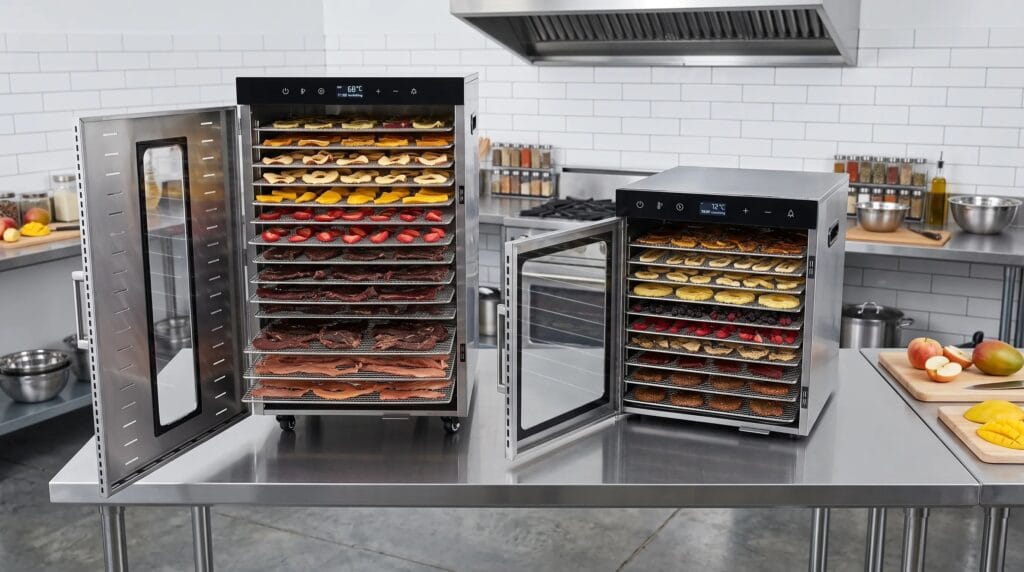
For dehydrate in the oven, you must use very gentle heat, ideally between 50 and 70°C, allow the humidity to escape and turn the food during drying. The method works for testing fruits, vegetables or herbs in small quantities, but it remains less regular than a real dehydrator.
The oven is therefore a good trial solution if you do not want to buy a dedicated appliance straight away. As soon as quantities increase or you are looking for a reproducible result, the food dehydrator becomes simpler, more stable and often more comfortable.
How to dehydrate in the oven step by step?
The method is to dry slowly, not to bake. You must prepare thin pieces, spread them in a single layer and maintain a low temperature long enough to let the water escape without browning the food.
- Cut thin and regular: the more homogeneous the slices, the more predictable the drying.
- Arrange without overlapping: air should circulate around each piece.
- Set the oven low: aim for 50 to 70°C depending on the food and the precision of the oven.
- Let the moisture out: open the door slightly if the oven retains too much steam.
- Return during the cycle: this limits soft areas and overly dry faces.
- Test after cooling: hot food often appears softer than it will when cold.
Verdict: The oven works very well for a first attempt, but it requires more supervision. The critical point is not the exact time: it is the absence of humidity in the core before storage.
Which ovens are compatible with dehydration?
The best oven for dehydrating is one that can maintain a low temperature stably. A ventilated oven is generally more suitable, because the air circulates better and evacuates humidity more easily.
A traditional oven can work, but it requires more rotation of the plates and a door that is sometimes ajar. Mini ovens are possible for small quantities, as long as they don’t get too hot even at the lowest setting.
| Oven type | Compatibility | Point of vigilance | Good use |
|---|---|---|---|
| Fan oven | The best option in the oven | Watch the edges, which sometimes dry more quickly | Fruits, fine vegetables, herbs, mushrooms |
| Traditional oven | Possible | Air less mobile, plates to be reversed | Small trials and limited quantities |
| Combined steam oven | Only if dry mode available | Do not use the steam function | Gentle drying with ventilation if the mode allows it |
| Mini oven | Possible but less stable | Heat often close to food | Herbs, small rounds, rapid tests |
Verdict: if your oven goes really low and vents properly, you can dehydrate. If the actual minimum often exceeds 80°C, you are more likely to cook, brown or harden the exterior.

Stainless steel dehydrator 10 trays – 800 W, 30 to 90°C
- 10 stainless steel trays for drying several preparations in a single session.
- 800 W power for regular drying of fruits, vegetables, herbs or homemade preparations.
- Adjustable temperature from 30 to 90°C to adapt drying to fragile foods as well as more intensive needs.
What temperature should I use to dehydrate in the oven?
The right temperature depends on the food, but the objective remains the same: to remove the water without cooking thoroughly. For most fine fruits and vegetables, a range of 50 to 70°C is a reasonable basis.
Aromatic herbs require more gentleness to keep their scent. Tomatoes, mushrooms or very juicy fruits may require longer, but not necessarily hotter. Raising too high often results in a food that is dry on the surface and still moist in the center.
- Herbs: low temperature, close monitoring.
- Sliced fruit: gentle to moderate heat, long cycle.
- Fine vegetables: regular cut, flipping while drying.
- Mushrooms: ventilated slices, storage only once completely dry.
Caution: Home oven thermostats are sometimes inaccurate at low temperatures. If your food is browning quickly, sticking heavily, or cooking instead of drying, lower the setting, open the door slightly, or reduce the thickness of the slices.
Oven or dehydrator: what is the concrete difference?
The main difference is regularity. A dehydrator is designed to circulate air around multiple trays at low temperatures, whereas an oven is designed primarily for baking.
In the oven, you must compensate: monitor, turn, partially open, move the plates. With a dehydrator, drying is more predictable, especially on mass-prepared fruits, vegetables or herbs.
| Criterion | Oven dehydration | Food dehydrator |
|---|---|---|
| Initial objective | Bake, roast, heat | Dry food slowly |
| Airflow | Varies depending on the oven | Designed to wick away moisture |
| Low temperature | Sometimes imprecise | Dedicated setting, easier to reproduce |
| Useful capacity | Limited by plates | Several trays stacked |
| Monitoring | More common | More comfortable on long cycles |
Verdict: keep the oven to discover the method or dry occasionally. Switch to a dehydrator if you want to prepare regular batches, save useful space and limit inconsistent results.
To understand the overall benefit of this conservation method, you can read our guide on what is a dehydrator used for. If your objective is above all to succeed in the fruits, the guide how to dehydrate fruit details cut, texture and storage.
What foods can you dehydrate in the oven?
The best candidates for the oven are foods that are thinly cut and easy to monitor. Fruits, vegetables, mushrooms and herbs give the most accessible results.
Avoid very thick pieces, very fatty preparations or foods that require strict health safety if you have not yet mastered the time and temperature. The oven can give a good taste result, but it does not replace a controlled preservation method if the food remains moist.
- Easy: apples, pears, bananas, herbs, citrus zest.
- Intermediate: tomatoes, mushrooms, zucchini, onions.
- To watch out for: very juicy fruits, thick slices, sticky sweet preparations.
- To avoid without a strict method: meats, fish and sensitive preparations.

Professional food dehydrator 24 trays
- 24 trays to process large volumes without multiplying cycles.
- Professional format suitable for regular production of fruits, vegetables, herbs or dried preparations.
- Large capacity useful for organizing a more productive and constant dehydration station.
How to store dehydrated foods in the oven?
Preservation does not begin at the time of storage, but at the time of the drying test. Let a few pieces cool, cut them down the center and check to make sure there are no damp, shiny or mushy areas left.
Then store in a clean, dry and airtight container, away from light and heat. If condensation appears in the first few days, the batch was not dry enough: it must be allowed to dry again rather than kept as is.
Practical advice: note your oven setting, cutting thickness and time obtained. As each oven heats differently, your own benchmarks are better than a universal time copied without control.
The oven has convinced you, but you want more regular?
Discover our collection of dehydrators for drying fruits, vegetables, herbs and homemade preparations with more capacity, control and comfort than in the oven.
Oven Dehydration FAQ
Can you dehydrate in the oven without rotating heat?
Yes, but the result is less regular. You have to turn the food, invert the plates and let the moisture escape more often.
Should you leave the oven door open?
Often, yes, at least slightly, especially if the oven retains humidity. The goal is to dry, not to keep steam in the cavity.
How long does it take to dehydrate in the oven?
The time varies depending on the food, thickness, ventilation and oven. Allow several hours and always validate the texture after cooling.
Does the oven really replace a dehydrator?
It helps out for small tests. For regular batches, multiple trays and more consistent drying, a dehydrator remains more suitable.