
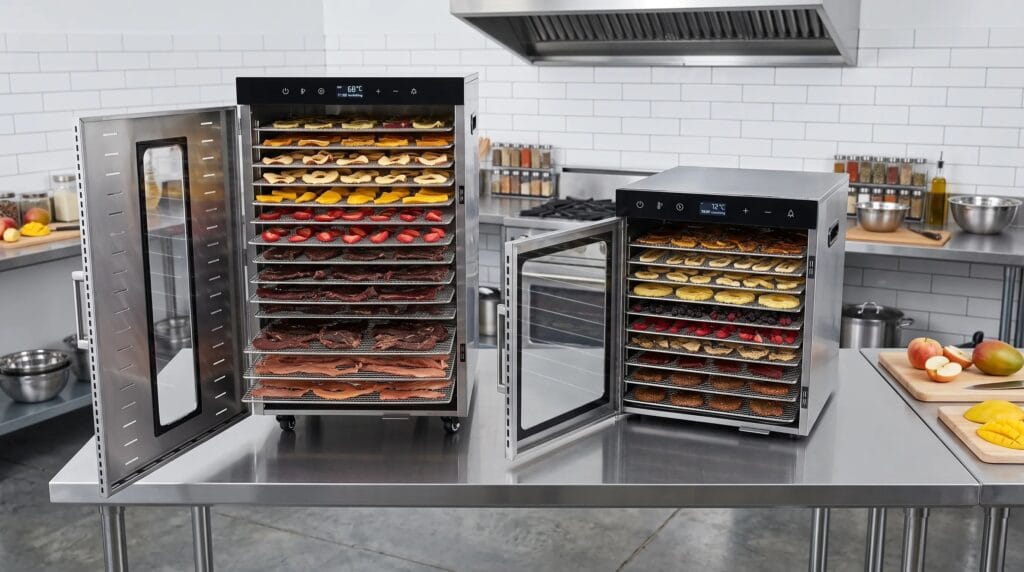
A dehydrator used to remove water from foods at low temperatures to prolong their storage while concentrating flavors. It is especially useful for fruits, vegetables, herbs, mushrooms, dry snacks and preparations to be stored without residual moisture.
The right choice depends less on the number of programs than on three points: useful capacity, regularity of air flow and ease of cleaning. For long conservation, drying must then be combined with airtight storage, sometimes under vacuum.
What is a food dehydrator really for?
The main question is simple: Is a dehydrator just a gadget for dried fruit? No. It is a preservation tool that stabilizes food by significantly reducing its humidity.
In practice, it is used to prepare dry snacks, limit seasonal waste, store herbs, dry mushrooms or produce regular garnishes for the kitchen. Unlike the oven, it works more gently, with air circulation designed to evacuate humidity without cooking roughly.
- Fruits: apples, bananas, strawberries, citrus fruits, pears.
- Vegetables: tomatoes, zucchini, fine carrots, onions.
- Aromatic products: herbs, garlic, pepper, zest.
- Dry preparations: crackers, fruit leather, suitable protein snacks.

Stainless steel dehydrator 10 trays – 800 W, 30 to 90°C
- 10 stainless steel trays for drying several preparations in a single session.
- 800 W power for regular drying of fruits, vegetables, herbs or homemade preparations.
- Adjustable temperature from 30 to 90°C to adapt drying to fragile foods as well as more intensive needs.
Which foods should be dehydrated without losing quality?
The right question is not just “what can be dried?”, but which food remains of real interest after drying. The best results come from foods rich in flavor, cut regularly and sufficiently fine.
Fruits make easy-to-store snacks. Tomatoes, mushrooms and herbs become concentrated ingredients. For dried meats, you have to be much more rigorous: marinade, fine cutting, suitable temperature and strict hygiene are essential.
Field advice: weigh a tray before and after drying during the first sessions. This helps to understand the level of water lost and to avoid the most common trap: storing a food that is still too soft in the center, therefore unstable in storage.
To compare with other storage methods, the guide on vacuum food storage chart helps distinguish dry storage, refrigeration, freezing and vacuum packaging.
Dehydrator, oven or sous vide: which method to choose?
The answer depends on the objective. The dehydrator dries, the vacuum protects from the air, the freezer blocks the evolution by the cold. These methods therefore do not meet the same need.
| Method | Best use | Limit to know | Good reflex |
|---|---|---|---|
| Dehydrator | Fruits, vegetables, herbs, dried snacks | Does not replace sterilization | Then store in a dry place away from air. |
| Low temperature oven | Occasional troubleshooting | Less regular heat, stronger monitoring | Leave the door ajar if necessary |
| Vacuum | Fresh, cooked, portioned or frozen products | Do not dry the food | Use a suitable bag and reliable welding |
| Freezing | Long shelf life of fresh food | Risk of frost and cold burn | Combine with sous vide to protect the texture |
Verdict: choose the dehydrator if you want a dry, light and concentrated food. To protect a fresh or already cooked product, vacuum packaging remains more suitable; the article on the difference between vacuum sealer and freezer completes this logic well.
Which dehydrator should you choose based on your volume?
To choose correctly, start with your actual cadence. Small family use does not have the same constraints as regular production fruits, vegetables, herbs or snacks.
The number of trays matters, but the consistency of drying matters more. A larger appliance allows you to spread the food in a thin layer, therefore drying more cleanly without overloading the trays.
- Occasional use: favor a simple format, easy to store and clean.
- Regular use: aim for several platforms and a stable structure.
- More serious production: prefer a higher capacity to limit repeated sessions.

Professional food dehydrator 24 trays
- 24 trays to process large volumes without multiplying cycles.
- Professional format suitable for regular production of fruits, vegetables, herbs or dried preparations.
- Large capacity useful for organizing a more productive and constant dehydration station.
Mistakes that ruin good dehydration
The main risk is not missing the taste, but store food that is still too wet. Residual moisture promotes softening, odors and unstable storage.
Also avoid irregular slices, overloaded trays and immediate storage in a closed container while the food is still warm. Let cool, check the texture, then store in a clean, dry, airtight container.
For very fatty, very thick or sensitive foods, be careful: dehydration does not correct a lack of hygiene or a fragile raw material. It works well when the preparation is clear from the start.
Need a more regular drying station?
Discover our collection of dehydrators to choose a format consistent with your volume, your foods and your frequency of use.
Dehydrator FAQ
Does a dehydrator replace a vacuum sealer?
No. The dehydrator removes the water, while the vacuum sealer removes the air around the food. The two methods can be complementary for certain dry products.
Can you dehydrate moist or sauced foods?
Not directly. Very liquid sauces and preparations require a suitable technique, often on special foil, with more careful monitoring.
How long does it take to dehydrate fruit?
The time varies depending on the thickness, the water contained in the fruit and the temperature. Thin, regular slices always give a more reliable result.
How to store food after dehydration?
Let them cool, check that they are completely dry, then store them in an airtight container away from humidity, light and heat.