
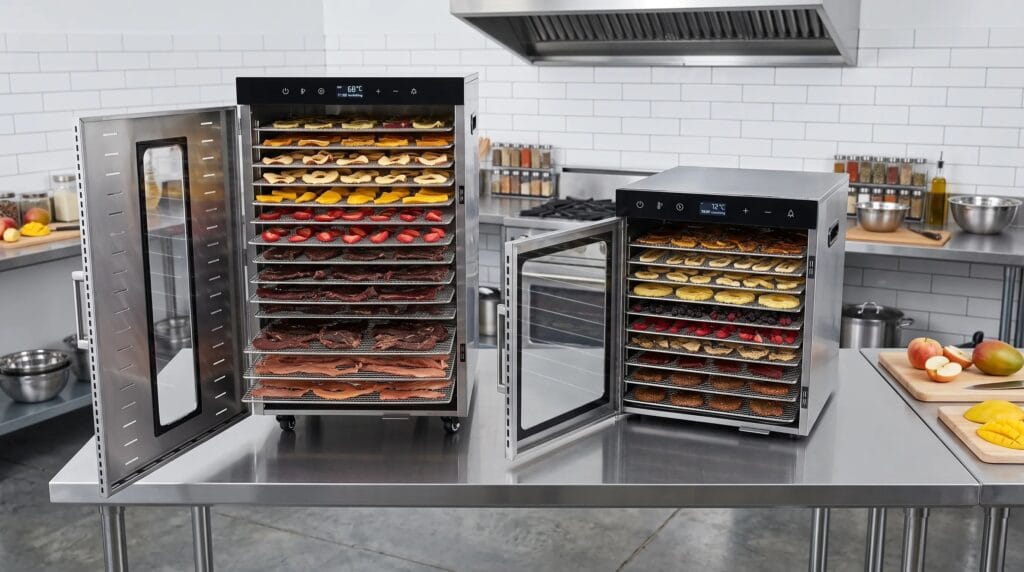
The good dehydrator temperature depends mainly on the food: 35 to 40°C for herbs, 45 to 50°C for mushrooms, 55 to 60°C for most fruits and vegetables, and 65 to 70°C for dried meat. The thicker or wetter the cut, the longer the time, but going too high doesn’t always speed up drying: it can harden the exterior and keep moisture in the core.
What temperature should you set on a food dehydrator?
To properly set up a dehydrator, start from fragility of food rather than a single temperature. Herbs require a low temperature, fruits tolerate moderate heat, and meat requires a higher range for safe drying.
In practice, the majority of domestic uses fall between 45 and 60°C. This zone allows the water to be removed gradually without cooking the food. The true winning setting combines three elements:
- a suitable temperature to the food family;
- regular installments, neither too thick nor stuck together;
- stable air circulation on all platforms.
If you’re a beginner, start in the middle of the recommended range, then adjust according to the result: soft texture, brittle, still damp or too dry.

Stainless steel dehydrator 10 trays – 800 W, 30 to 90°C
- 10 stainless steel trays to dry several preparations in a single session
- 800 W power for regular drying of fruits, vegetables, herbs or homemade preparations
- Adjustable temperature from 30 to 90°C to adapt drying to fragile foods as well as more intensive needs
Dehydrator Temperature Chart by Food
Here are useful guidelines for quickly choosing the temperature depending on the food. The times remain indicative: they vary according to the thickness, the water content, the filling of the trays and the actual power of the device.
| Food | Recommended temperature | Recommended preparation | End of drying mark |
|---|---|---|---|
| Pineapple | 55 to 60°C | Thinly sliced, core removed if necessary | Soft, non-sticky, concentrated fragrance |
| Tomato | 55 to 60°C | Half slices or quarters, excess seeds removed | Soft to tough, without wet pockets |
| Banana | 55 to 60°C | Regular washers, not too thick | Soft or slightly brittle depending on taste |
| Apricot | 55 to 60°C | Apricot halves or quarters, skin side down | Soft, dense, without visible juice |
| Mushroom | 45 to 50°C | Thin strips, brushed rather than hardened | Brittle or very dry to the touch |
| Jerky type meat | 65 to 70°C | Thin strips, marinade, strict hygiene | Dry, foldable, without soft spots |
| Orange | 55 to 60°C | Fine and regular washers | Dry slice, still slightly soft |
| Lemon | 55 to 60°C | Thin slices, seeds removed if possible | Dry, fragrant, not moist in the center |
| Apple | 55 to 60°C | Thin strips, skin kept or removed | Soft to crispy depending on thickness |
| Aromatic herbs | 35 to 40°C | Leaves clean, well dried, in a light coat | Friable leaves, color preserved |
| Chili pepper | 50 to 55°C | Whole small or split in two, gloves recommended | Dry, light, brittle |
| Onion | 50 to 55°C | Thin, separate lamellae | Very dry, brittle, without residual moisture |
Verdict: for fruits like pineapple, banana, apricot, orange or lemon, the safest range remains 55 to 60°C. Instead, go down to around 45 to 50°C for mushrooms, and go up to around 65 to 70°C only for dried meat.
Why temperature alone is not enough
The temperature sets the framework, but the result also depends on the cut, the air and the starting humidity. Two bananas dried at 58°C can come out very different if one is cut into thin rounds and the other into thick slices.
The most common mistake is to go too high to go faster. On some very moist foods, the exterior may dry quickly while the center remains moist. Drying appears to be complete, but conservation becomes less reliable.
Practical advice: Space out pieces, avoid overcrowded trays and turn very moist foods during the cycle if necessary. More regular drying is better than an aggressive temperature.
For fruits, you can also consult our guide dedicated to how to dehydrate fruit in a dehydrator. It completes this picture with a logic more focused on texture and preparation.
Which dehydrator should you choose to keep a stable temperature?
To keep a stable temperature, choose a device with precise adjustment, regular ventilation and adapted capacity. A small volume is suitable for one-off tests; a large volume becomes more comfortable if you often dry fruits, vegetables, mushrooms or preparations in quantity.
Stability matters because an overfilled deck or poor ventilation creates slower zones. Conversely, a more generous dehydrator allows food to be distributed better, therefore drying more cleanly.

Professional food dehydrator 24 trays
- 24 trays to process large volumes without multiplying cycles
- Professional format suitable for regular production of fruits, vegetables, herbs or dried preparations
- Large useful capacity to organize a more productive and constant dehydration station
If you are still unsure about the benefits of this equipment, our article what is a dehydrator used for helps to identify uses: conservation, anti-waste, homemade snacks, herbs, mushrooms or more regular preparations.
Temperature errors to avoid
To succeed in drying, especially avoid extreme settings and approximations on sensitive foods. A correct temperature better protects the texture, but also the preservation.
- Do not dry herbs too hot: above 45°C, they lose color and fragrance more quickly.
- Do not overload the trays: air must pass between the pieces.
- Do not mix very moist and very dry foods: durations become difficult to control.
- Don’t store too quickly: let cool, then check for condensation in the container.
- Be strict with meat: use a hygienic preparation, thin slices and a suitable temperature.
The right reflex: Note your best settings for your usual foods. Your personal table will become more precise than any general reference, because it will integrate your device, your cuts and your quantities.
Need an adjustable and regular dehydrator?
Choose a model adapted to your volumes: compact to start, large capacity to chain sessions of fruits, vegetables, herbs, mushrooms or dried meat.
Dehydrator Temperature FAQ
What temperature to dry fruit in a dehydrator?
Most fruits dry between 55 and 60°C. Cut them finely and regularly to obtain a uniform texture.
What temperature for mushrooms in the dehydrator?
Instead, set between 45 and 50°C. Mushrooms dry best in thin strips, without being washed with plenty of water.
What temperature to make jerky?
For jerky type meat, generally use 65 to 70°C, with thin strips, clean preparation and careful storage.
Can we speed up drying by raising the temperature?
Not always. Too high a temperature can dry the exterior too quickly and leave moisture in the center. Better to adjust the thickness and ventilation.