
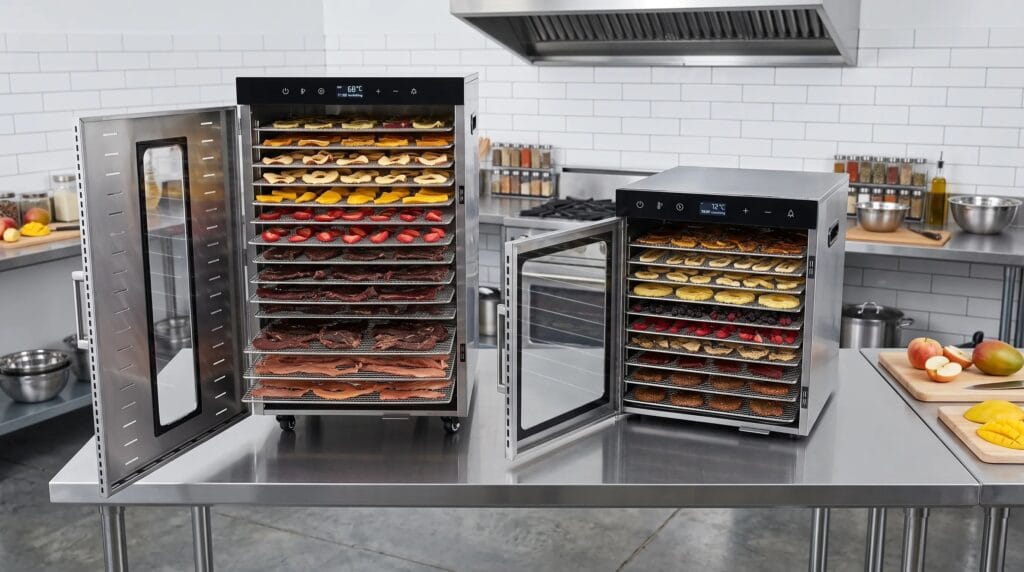
The dehydrator drying time varies mainly depending on the water contained in the food, the thickness of the cut and the filling of the trays. Often allow 6 to 12 hours for fruits, 4 to 10 hours for vegetables, 4 to 8 hours for mushrooms, 2 to 6 hours for herbs and 4 to 8 hours for jerky-type meat.
How to estimate drying time in a dehydrator?
To estimate a drying time, start from the food and then correct according to the cut. A thin washer dries quickly; a thick or very juicy wedge can double the time.
The most reliable benchmarks are simple:
- thin and regular slices: more uniform drying;
- lightly loaded trays: better air circulation;
- suitable temperature: cleaner drying, without outer crust;
- control at end of cycle: touch matters more than the exact time.
If you want to cross-reference the durations with the settings, also keep our guide on hand on hand. dehydrator temperature per food.

Stainless steel dehydrator 10 trays – 800 W, 30 to 90°C
- 10 stainless steel trays to dry several preparations in a single session
- 800 W power for regular drying of fruits, vegetables, herbs or homemade preparations
- Adjustable temperature from 30 to 90°C to adapt drying to fragile foods as well as more intensive needs
Dehydrator Drying Times Chart by Food
This table gives realistic ranges for regularly cut foods. Always check the texture before storing: food that is still moist at the core will not keep as well.
| Food | Recommended cut | Marker temperature | Indicative drying time | Expected texture |
|---|---|---|---|---|
| Apple | Thin strips | 55 to 60°C | 6 to 10 a.m. | Soft to slightly crispy |
| Pear | Regular slats | 55 to 60°C | 8 to 12 p.m. | Soft, without visible juice |
| Banana | Thin washers | 55 to 60°C | 6 to 12 p.m. | Soft or brittle depending on thickness |
| Pineapple | Thin slices | 55 to 60°C | 8 to 2 p.m. | Soft, concentrated fragrance |
| Apricot | Half fruit or quarters | 55 to 60°C | 10 a.m. to 4 p.m. | Soft and dense |
| Fig | Halves or quarters | 55 to 60°C | 10 a.m. to 6 p.m. | Soft, non-sticky to the core |
| Strawberry | Thin slices | 50 to 55°C | 6 to 10 a.m. | Dry, light, fragrant |
| Grape | Split or blanched grains | 55 to 60°C | 6 to 30 p.m. | Raisin type, still soft |
| Tomato | Quarters or half slices | 55 to 60°C | 8 a.m. to 4 p.m. | Soft to tough, without wet pockets |
| Carrot | Rounds or julienne | 50 to 55°C | 6 to 10 a.m. | Very dry, brittle or firm |
| Zucchini | Thin washers | 50 to 55°C | 5 to 9 a.m. | Dry, slightly supple |
| Pepper | Thin strips | 50 to 55°C | 6 to 10 a.m. | Soft to brittle |
| Onion | Separated slats | 50 to 55°C | 6 to 10 a.m. | Dry and brittle |
| Button mushroom | Thin strips | 45 to 50°C | 4 to 8 hours | Brittle or very dry |
| Porcini or thick mushroom | Regular slices | 45 to 50°C | 6 to 10 a.m. | Dry, light, without damp flexibility |
| Parsley, basil, mint | Light layer leaves | 35 to 40°C | 2 to 5 hours | Friable, color preserved |
| Thyme, rosemary | Small branches spaced apart | 35 to 40°C | 2 to 4 hours | Very dry, brittle leaves |
| Orange | Thin washers | 55 to 60°C | 8 to 2 p.m. | Dry, still slightly supple |
| Lemon | Thin washers | 55 to 60°C | 7 to 12 p.m. | Dry, fragrant, not moist in the center |
| Chili pepper | Whole small or split | 50 to 55°C | 6 to 12 p.m. | Dry, light, brittle |
| Jerky type meat | Thin strips | 65 to 70°C | 4 to 8 hours | Dry, foldable, without soft spots |
Verdict: the time indicated should remain a range, not an absolute timer. For very juicy foods like pineapple, tomatoes, figs or grapes, allow a margin and check the texture before storing.
Why the same food can take twice as long
The same food can dry in 6 hours or 12 hours depending on its thickness, its humidity and the quantity placed in the device. The time displayed in a table becomes reliable only if the pieces are regular and well spaced.
Practical advice: launch a first check before the theoretical end, then extend in increments of 30 to 60 minutes. This allows you to avoid overdrying fragile foods while identifying pieces that are still damp.
For fruits in particular, our guide to dehydrate fruit in a dehydrator complete this table with the right preparation actions.
Which device should you choose if you often dry large volumes?
If you multiply the sessions, the right choice is not only the power: it is the useful capacity. The more you distribute the food without stacking it, the more even the drying will be.
A compact model is enough for a few fruits or herbs. For crops, jars, mushrooms or regular preparations, a large number of trays avoids restarting several cycles.

Professional food dehydrator 24 trays
- 24 trays to process large volumes without multiplying cycles
- Professional format suitable for regular production of fruits, vegetables, herbs or dried preparations
- Large useful capacity to organize a more productive and constant dehydration station
Mistakes that unnecessarily lengthen drying
Most cycles that are too long come from poor filling or uneven cutting. Correcting these points often saves more time than raising the temperature.
- Cut too thick: the center remains moist for a long time.
- Glue the pieces: air circulates poorly between foods.
- Mixing very different foods: the herbs will be ready well before the tomatoes.
- Open too often: the temperature and airflow become less stable.
- Store before cooling: condensation can re-moisten the product.
The right reflex: record your actual times per food, cut and device. In two or three sessions, you obtain a much more precise house chart than general benchmarks.
Need more regular and more productive drying?
Choose a dehydrator adapted to your volumes to better distribute food, limit repeated cycles and obtain a more consistent texture.
Dehydrator Drying Time FAQ
How long does it take to dry fruit in a dehydrator?
Most fruits require 6 to 12 p.m., but very juicy fruits like pineapple, fig or grapes may take longer.
How do you know if a food is dry enough?
It should no longer have a damp area in the heart. Depending on the food, the texture can be soft, brittle or tough, but never wet.
Can we mix several foods in the same cycle?
Yes, if their times and temperatures are close. Avoid mixing fragile herbs, very juicy fruits and meat in the same session.
Should you turn food over while drying?
This is not always mandatory, but it is useful for thick pieces, very humid or placed on heavily loaded trays.