
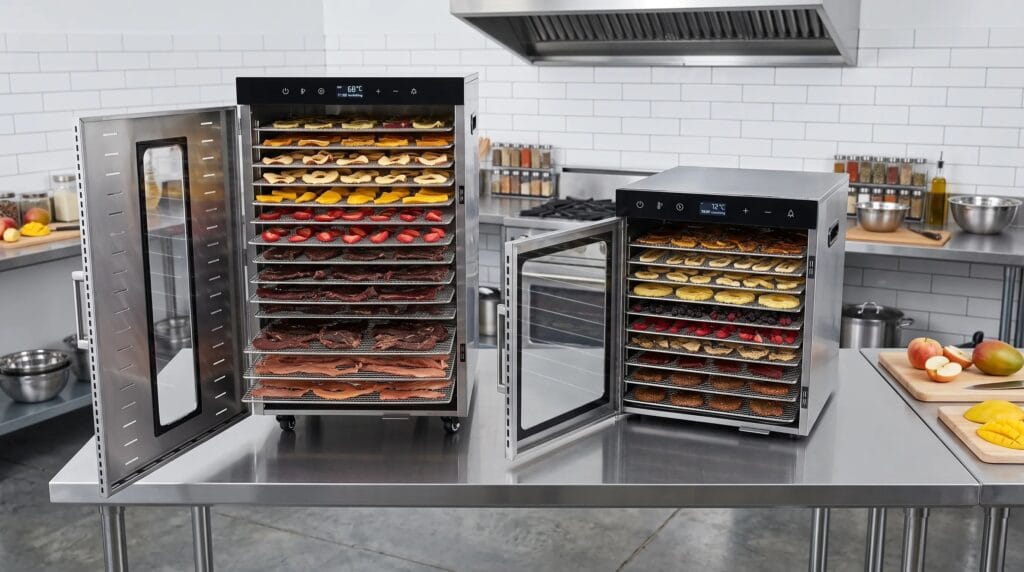
A food dehydrator is chosen primarily based on the volume to be dried, ventilation consistency, and temperature range. For fruits, vegetables, herbs, or homemade preparations, a stable and sufficiently capacious appliance is better than a small model that quickly gets saturated.
The right choice is therefore not just a matter of price: it’s primarily a question of throughput, drying surface, and temperature control.
Which food dehydrator to choose for regular use?
For regular use, choose a dehydrator with multiple trays, adjustable temperature, and homogeneous air circulation. This trio prevents half-dried foods, endless batches, and inconsistent results.
A small dehydrator may suffice for testing a few apple slices. However, as soon as you dry harvests, large quantities of herbs, tomatoes, mushrooms, or homemade snacks, capacity quickly becomes the real criterion.
- 5 to 8 trays: practical for discovering dehydration, but quickly limited.
- 10 trays: good compromise for fruits, vegetables, herbs, and small batches.
- 20 trays and more: more suitable for large volumes, regular processing, or semi-professional use.
To understand basic uses before buying, you can also read our guide on what a dehydrator is used for.

Stainless Steel Dehydrator 10 Trays – 800 W, 30 to 90°C
- 10 stainless steel trays for drying multiple preparations in a single session
- 800 W power for consistent drying of fruits, vegetables, herbs, or homemade preparations
- Adjustable temperature from 30 to 90°C to adapt drying for delicate foods as well as more intensive needs
What criteria truly make a difference in drying?
Important criteria include ventilation, usable surface area, temperature precision, and ease of cleaning. A food dehydrator should dry slowly, cleanly, and repeatably, without requiring food to be moved every hour.
The temperature should remain low enough to preserve delicate foods, yet flexible enough to speed up certain preparations. In practice,a wide range helps transition from delicate herbs to moister fruits without changing machines.
Pro tip:do not overfill trays to the point of blocking air circulation. An even layer, pieces of uniform thickness, and a little space between foods yield more reliable results than an overloaded batch.
For very watery foods like tomatoes, juicy fruits, or mushrooms, consistency matters as much as power. To set your drying times, also consult ourdehydrator drying time chart.
Food Dehydrator 10 Trays or 24 Trays: Which one to choose?
The 10-tray model is the best choice if you want a versatile, easy-to-integrate, and already robust appliance. The 24-tray model becomes relevant if you process large volumes or want to reduce the number of cycles.
| Need | Recommended Size | Why |
|---|---|---|
| Fruits, vegetables, and herbs for home use | 10 trays | Comfortable surface area without an overly bulky appliance. |
| Abundant harvests, repeated batches, regular processing | 24 trays | More usable surface area, fewer batches, better organization. |
| Small kitchen or limited counter space | 10 trays | Easier to install and store. |
| Pro, semi-pro, or seasonal production | 24 trays | Capacity suited when volume takes precedence over compactness. |
Verdict:if you primarily dry for personal consumption, the 10-tray model is the most rational choice. If you’re processing crates, herbs, preparations, or regular batches,the 24-tray model avoids working in multiple small batches.

Professional Food Dehydrator 24 Trays
- 24 trays for processing large volumes without multiplying cycles
- Professional format suitable for regular production of dried fruits, vegetables, herbs, or preparations
- Large usable capacity for a more productive and consistent dehydration station
Mistakes to avoid before buying
The main mistake is choosing a unit that’s too small to save a few euros. An undersized dehydrator requires multiple cycles, increasing time, consumption, and handling.
Also avoid choosing based solely on power. High power doesn’t help if air circulation is poor or trays are difficult to load properly. Conversely, good usable volume, adjustable temperature, and easy-to-clean trays make the appliance more enjoyable long-term.
- Do not mix very thin and very thick pieces in the same cycle.
- Do not overload trays: air must circulate.
- Do not dry all foods at the same temperature.
- Do not choose a compact size if you already know you’ll be processing seasonal volumes.
Need a unit suited to your volumes?
Compare our food dehydrators to choose between the versatile 10-tray model and large professional capacity.
Food Dehydrator FAQ
What is the best food dehydrator for beginners?
A 10-tray model is often the best compromise: capacious enough for progression, without being too bulky.
What temperature to use with a food dehydrator?
It depends on the food. Herbs require a low temperature, while fruits, vegetables, and wetter preparations generally tolerate a higher temperature.
Do you need a professional food dehydrator at home?
Not necessarily. It becomes worthwhile if you dry often, in large quantities, or want to reduce the number of cycles.
Does a food dehydrator consume a lot of energy?
It operates for a long time but at a moderate temperature. The most important thing is to properly fill the trays to avoid unnecessary cycles.


