
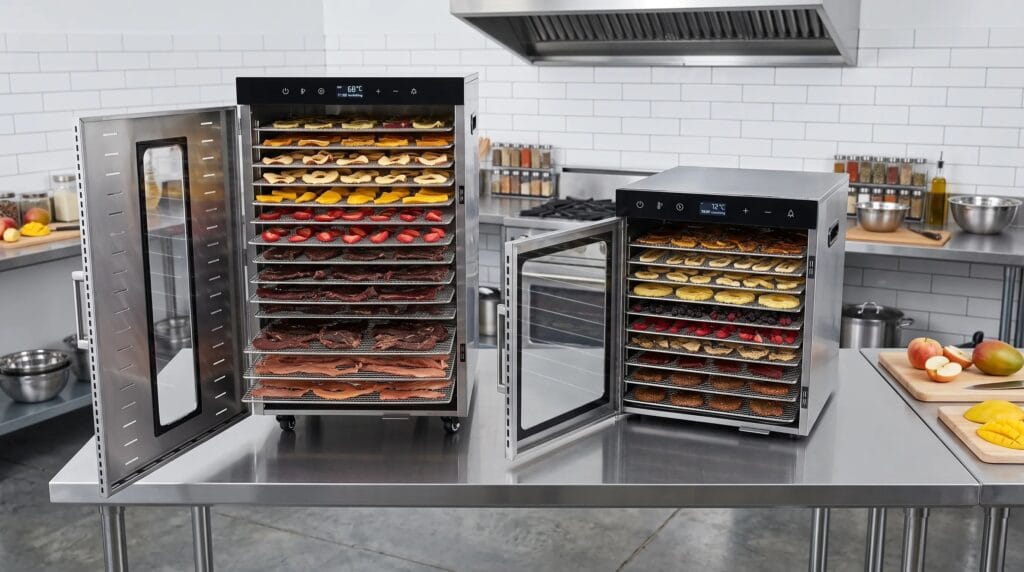
The difference between a dehydrator and a freeze dryer is due to the process: the dehydrator removes the water using ventilated hot air, while the freeze dryer freezes the food then removes the water under vacuum. Clearly, the dehydrator is simpler, more accessible and suitable for common uses; the freeze dryer maintains structure and rehydration better, but is much more technical.
If you are hesitating between the two, the real question is not “which is better?”, but what result you want to achieve : dried fruits, herbs, snacks and regular preparations, or very light foods with a long shelf life with a texture close to the original after rehydration.
What is the difference in principle between dehydration and freeze-drying?
The difference in principle is clear: dehydration evaporates water by gentle heat, while freeze-drying removes water from a frozen product using a vacuum. Both methods reduce moisture, but they don’t produce the same texture.
In a dehydrator, hot air circulates around the food. The water gradually migrates outwards, then evacuates. It is a direct, effective method for fruits, vegetables, herbs, mushrooms and certain dry preparations.
In a freeze dryer, the food is first frozen. The solid water then passes into the vapor state under vacuum: this is sublimation. The result is often very light, porous and quick to rehydrate, but the material is more complex.

Stainless steel dehydrator 10 trays – 800 W, 30 to 90°C
- 10 stainless steel trays for drying several preparations in a single session.
- 800 W power for regular drying of fruits, vegetables, herbs or homemade preparations.
- Adjustable temperature from 30 to 90°C to adapt drying to fragile foods as well as more intensive needs.
Dehydrator or freeze dryer: what result on the plate?
The most visible result concerns the texture. A dehydrated food becomes dry, concentrated and often denser. A freeze-dried food becomes very light, crumbly or crispy, with a better capacity to absorb water.
For dried apples, tomatoes, mushrooms, aromatic herbs or homemade snacks, the dehydrator produces a very useful result that is easy to integrate into the kitchen. For whole red fruits, dishes to rehydrate or very light hiking preparations, freeze-drying has a technical advantage.
| Criterion | Dehydrator | Freeze dryer |
|---|---|---|
| Principle | Hot air ventilated at low temperature | Freezing then removing the water under vacuum |
| Final texture | Dense, dry, soft or brittle depending on the food | Very light, porous, often crispy |
| Taste | Concentrated flavors, sometimes more candied | Taste closer to the initial food after rehydration |
| Rehydration | Possible, but texture often transformed | Very good on many foods |
| Common use | Fruits, vegetables, herbs, mushrooms, snacks | Long-life meals, fragile fruits, very long-term storage |
Verdict: choose the dehydrator if you want to regularly dry everyday foods. Reserve the freeze dryer for very specific needs where weight, rehydration and long-term storage take precedence over simplicity.
Which device is the easiest to use on a daily basis?
On a daily basis, the dehydrator is much simpler. Simply cut the food, distribute it on the trays, adjust the temperature and let the air circulate.
The freeze dryer imposes a more technical logic: freezing, vacuum cycle, management of the extracted humidity, very protective packaging and more demanding maintenance. It’s not impossible, but it’s not the same level of equipment.
- Dehydrator: ideal for learning quickly, testing several foods and producing regular batches.
- Freeze dryer: interesting if you already have a real need for long preservation, rehydration or light storage.
- Oven: trial solution, less regular, useful before purchasing a dedicated device.
If you first want to understand the possible uses, the guide what is a dehydrator used for details the foods and storage errors to avoid. To test without a dedicated device, our method for dehydrate in the oven gives a first practical approach.
What choice for fruits, vegetables, herbs and homemade preparations?
For fruits, vegetables, herbs and homemade preparations, the dehydrator is generally the best compromise. It is enough for most needs: apples, bananas, tomatoes, mushrooms, aromatic herbs, zest, crackers or dry garnishes.
The freeze dryer becomes relevant if you are looking for a very light texture, more faithful rehydration or long-term storage with suitable packaging. But for regular culinary use, it may be oversized.
Important point: neither the dehydrator nor the freeze dryer compensates for poor hygiene, damaged food or poorly closed packaging. After drying, storage must remain clean, dry, airtight and protected from humidity.

Professional food dehydrator 24 trays
- 24 trays to process large volumes without multiplying cycles.
- Professional format suitable for regular production of fruits, vegetables, herbs or dried preparations.
- Large capacity useful for organizing a more productive and constant dehydration station.
When should you prefer a freeze dryer?
A freeze dryer should be preferred when the main objective is very long-term preservation, maximum lightness or rehydration closer to the initial food. This is typically a choice for specialized needs, not for simply making dried fruit.
It can be relevant for meals that need to be stored for a long time, for hiking purposes, for certain professional preparations or for fragile foods whose shape we want to preserve. On the other hand, it requires more space, more method and a greater investment.
Tip of choice: If you are hesitant because you mainly want to dry fruits, vegetables and herbs several times a month, start with a dehydrator. If your goal is to build a long-lasting stock with rapid rehydration, freeze-drying deserves specific study.
Dehydrator or freeze dryer: which one to choose?
The right choice depends on your dominant constraint. For simplicity, cost of use, dried fruits and homemade preparations, the dehydrator wins. For preservation performance and rehydration, the freeze dryer is superior, but heavier to manage.
In practice, the majority of users who want to preserve better, reduce waste and prepare dry foods already get a lot with a good dehydrator. The freeze dryer responds to a more advanced logic, close to long-term technical storage.
| Your goal | Recommended choice | Why |
|---|---|---|
| Make homemade dried fruits | Dehydrator | Simple, regular, suitable for small and medium series |
| Dry herbs, tomatoes, mushrooms | Dehydrator | Very good compromise between result, capacity and ease |
| Prepare ultra-light meals to rehydrate | Freeze dryer | More porous texture and better water absorption |
| Discover dry conservation without a big budget | Dehydrator | More accessible and much easier to use |
| Very long-term technical storage | Freeze dryer | More advanced method, if the final packaging is controlled |
Verdict: the dehydrator is the logical choice for everyday food use. The freeze dryer is a more specialized tool, only interesting if its advantages really justify its cost, its size and its complexity.
Need a simple solution for drying your food?
Discover our collection of dehydrators to dry fruits, vegetables, herbs and homemade preparations with an accessible, regular method that is easy to integrate into daily life.
FAQ on the difference between dehydrator and freeze dryer
Lyophilist or lyophilizer: what is the right term?
The correct term is freeze dryer. “Lyophylist” is a common mistake, but it generally refers to the same type of device.
Does a dehydrator last as long as a freeze dryer?
Not under the same conditions. The freeze dryer can aim for longer storage if the packaging is perfectly adapted. The dehydrator remains excellent for everyday uses.
Can you rehydrate dehydrated foods?
Yes, but the texture does not always return to the original. Freeze drying generally gives better rehydration.
Which device to choose to start?
To start, choose a dehydrator instead. It is simpler, more accessible and more than sufficient for fruits, vegetables, herbs and homemade snacks.