
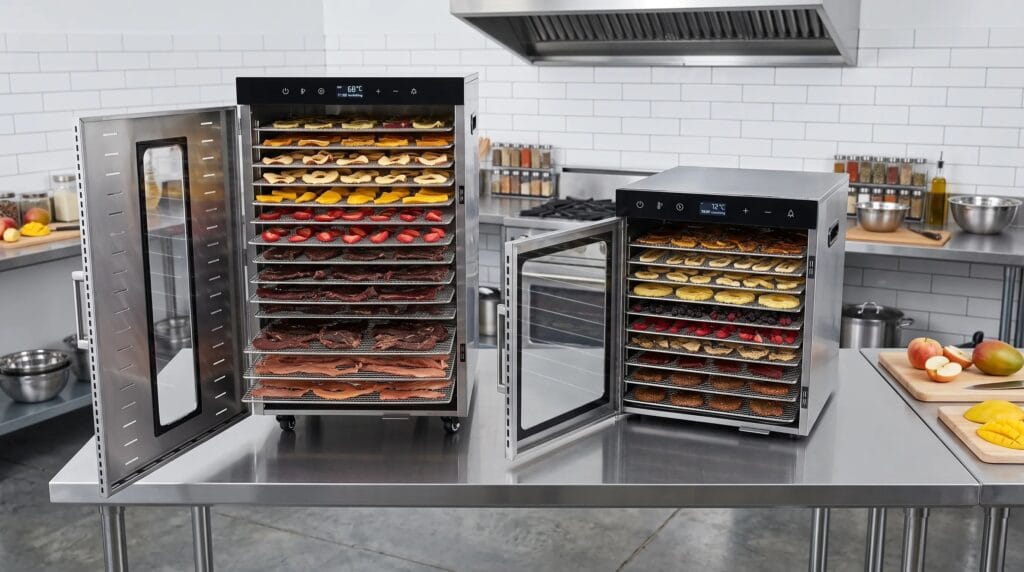
One food dehydrator works by circulating warm, dry air around the food to gradually evacuate its moisture. It does not try to cook like an oven: it dries slowly, at a controlled temperature, to concentrate the flavors and make the food more stable.
The result depends above all on three elements: temperature, air circulation and the thickness of the pieces. The more regular and well spaced the foods are on the trays, the more uniform the drying.
What is the principle of a food dehydrator?
A dehydrator removes the water contained in the food by gentle evaporation. A resistance heats the air, a fan distributes it throughout the room, then the humidity is gradually evacuated during the cycle.
This logic allows you to dry fruits, vegetables, herbs, mushrooms or fine preparations without burning them. To better understand the benefits of this method in terms of conservation and taste, you can also read our guide what is a dehydrator used for.
- Resistance produces controlled heat.
- The fan diffuses the air between the plates.
- The trays keep food spread to allow air to pass through.
- Cycle time lets the moisture gradually escape from the heart of the food.

Stainless steel dehydrator 10 trays – 800 W, 30 to 90°C
- 10 stainless steel trays for drying several preparations in a single session.
- Power 800 W for regular drying of fruits, vegetables, herbs or homemade preparations.
- Adjustable temperature from 30 to 90°C to adapt drying to fragile foods as well as more intensive needs.
How does hot air dry food?
Drying takes place in two stages: the surface humidity first disappears, then the water present in the center of the food slowly rises towards the outside. This is why a food can seem dry on the surface even though it remains too moist at the core.
The cut is therefore essential. Thin, even slices dry better than a mixture of thick and thin pieces. An overly loaded tray also slows down air flow and creates less well-dried areas.
Tip Vacuum Sealer Pro: for a first try, cut all the pieces to similar thickness and note the time obtained. You will then have a reliable basis to reproduce your cycles without guessing during each session.
What temperature should you choose for dehydrating?
The temperature must follow the fragility of the food. An aromatic herb requires gentle heat, while certain fruits, vegetables or thicker preparations can withstand a higher temperature.
| Type of food | Setting logic | Point of vigilance |
|---|---|---|
| Herbs and aromatics | Mild temperature | Preserve the fragrance and avoid browning the leaves. |
| Sliced fruit | Moderate temperature | Cut regularly to avoid a still damp core. |
| Fine vegetables | Moderate to sustained temperature | Adapt according to the water contained in the vegetable. |
| Thicker preparations | Longer cycle, adapted temperature | Check the texture in the center before storage. |
Verdict: the correct setting is not necessarily the hottest. Drying too aggressively can harden the exterior too quickly and leave moisture in the center.
Why does the capacity in trays change the result?
Capacity is not just about producing more. Above all, it allows you to spread food in thin layers, without stacking them, to allow air to circulate. This is what makes drying more regular.
If you are drying small quantities, a 10 tray format is already comfortable. For larger batches or regular production, a 24 trays avoids multiplying cycles and maintains a more efficient organization.

Professional food dehydrator 24 trays
- 24 trays to process large volumes without multiplying cycles.
- Professional format suitable for regular production of fruits, vegetables, herbs or dried preparations.
- Large capacity useful for organizing a more productive and constant dehydration station.
How do I know if drying is complete?
A properly dehydrated food should be dry all the way to the center, not just the surface. The texture depends on the product: an herb becomes crumbly, a fruit can remain supple, a finer preparation must lose its residual moisture.
Let cool before closing the container. If you lock up food that is still hot, condensation may form and compromise preservation. To extend storage, sous vide can complete drying on truly dry foods; our vacuum food preservation chart helps you choose the appropriate method.
Need more regular drying?
Choose a dehydrator adapted to your volume: 10 trays for regular use, 24 trays to produce more per cycle.
FAQ on how a food dehydrator works
Does a food dehydrator cook food?
No. It heats gently to remove moisture, but its purpose is drying, not baking like an oven.
Why should you cut food regularly?
Because pieces of the same thickness dry at the same rate. This avoids having some pieces too dry and others still wet in the center.
Can you fill all the trays of a dehydrator?
Yes, if the food remains spaced apart and the air circulates. The problem mainly comes from overloaded platters or overlapping pieces.
Should dehydrated foods be vacuum-packed?
This is useful for very dry foods, to protect them from air and humidity. You should not vacuum-pack food that is still damp in the hope of correcting incomplete drying.