
The Lidl Silvercrest dehydrator can be a good purchase if you occasionally want to dry a few fruits, herbs, or vegetables on a very low budget. It quickly becomes limited if you run regular batches, want a more stable temperature, or process large volumes.
Lidl advertises its Silvercrest Kitchen Tools model as a food dehydrator 250 W, sold online at 24,99 €, with overheat protection and intended for fruits, vegetables, herbs, meat, and fish. Here’s how to decide without buying too small.
Is the Lidl dehydrator sufficient for beginners?
Yes, for testing dehydration without a large investment. At this price, the main benefit is simple: discover food drying in small quantities, without committing to the budget of a more robust stainless steel appliance.
The model available at Lidl is presented under the brand Silvercrest Kitchen Tools, with a power of 250 W. Its advertised uses cover fruits, vegetables, herbs, meat, and fish, as well as preparing dried fruits without added preservatives. This is consistent for occasional family use, but one must be realistic: the capacity, speed, and consistency will not match those of a more powerful model.
- Good choice if you occasionally dry a few apples, bananas, herbs, or tomatoes.
- Less suitable if you want to prepare several kilograms, run consecutive sessions, or achieve very precise consistency.
- Avoid as a primary solution if you plan to regularly produce snacks, dried goods, or batches for a business.

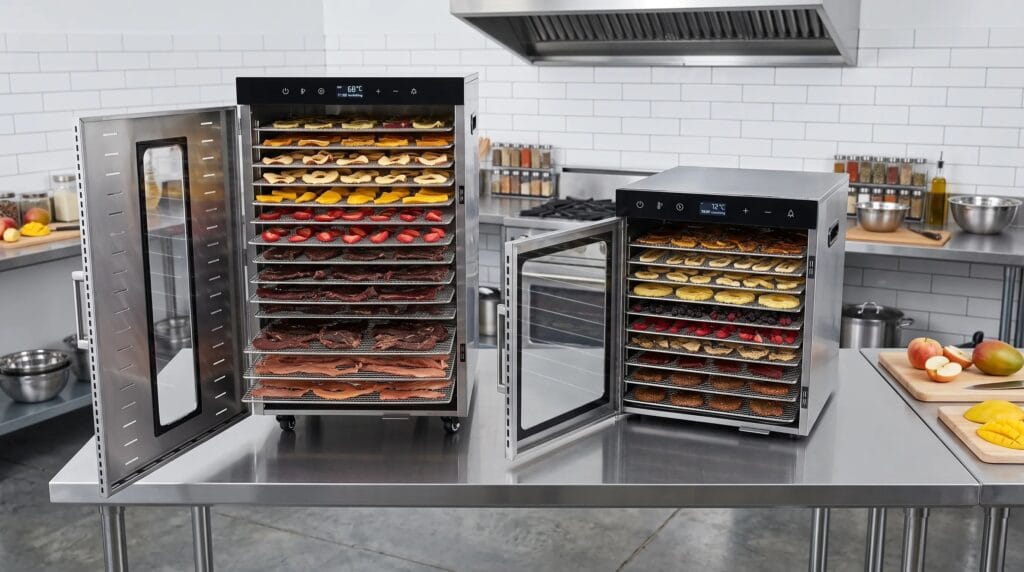
Stainless Steel Dehydrator 10 Trays – 800 W, 30 to 90°C
- 10 stainless steel trays for drying multiple preparations in a single session
- 800 W power for consistent drying of fruits, vegetables, herbs, or homemade preparations
- Adjustable temperature from 30 to 90°C to adapt drying for delicate foods as well as more intensive needs
What are the practical limitations of a Lidl dehydrator?
The main limitation is the pace. A small, entry-level dehydrator can be useful, but it shows its weaknesses as soon as batches become long, heavy, or repeated.
In practice, the most common mistake is to look only at the price. For a dehydrator, you also need to consider the drying surface, power, ventilation, temperature range, and ease of cleaning. A lightweight appliance may be suitable for testing a recipe; it becomes frustrating if you want to dry summer fruits in quantity, prepare jerky, or organize multiple homogeneous trays.
Practical tip: if you have to restart multiple cycles to get the desired quantity, the cheap model stops being truly economical. Time, energy, and monitoring also count.
Lidl, 10 trays or 24 trays: which format to choose?
Choose Lidl for testing, 10 trays for regular use, 24 trays for volume. The right format depends less on the initial price than on the quantity you want to dry per session.
| Need | Lidl Dehydrator 250 W | Stainless Steel Dehydrator 10 Trays | Professional Dehydrator 24 Trays |
|---|---|---|---|
| Occasional Discovery | Very suitable for testing | Possible, but more involved | Oversized |
| Common fruits, herbs, and vegetables | Capacity quickly becomes limited | Best compromise | Useful for large volumes |
| Batch organization | Uncomfortable | Good for family or semi-professional use | Better suited for batches |
| Initial budget | Very low | Higher, but more durable | Productive investment |
Verdict: if you just want to try, Lidl is sufficient. If you already know you’ll be drying often, the choice between a 10 or 24 tray dehydrator becomes more rational than an entry-level purchase that is replaced too quickly.

Professional Food Dehydrator 24 Trays
- 24 trays for processing large volumes without multiplying cycles
- Professional format suitable for regular production of dried fruits, vegetables, herbs, or preparations
- Large usable capacity for a more productive and consistent dehydration station
When to avoid the Lidl dehydrator?
Avoid it if your need is already clear and consistent. A very economical purchase rarely proves to be the right choice when you’re looking for consistency, a large usable area, or a truly organized drying process.
For frequent use, start by defining your volume: a few trays for testing, about ten trays for daily use, or a large format to consolidate batches. If you are still unsure about suitable foods, the article what a dehydrator is used for helps clarify uses before choosing your appliance.
Above all, remember this: the Lidl dehydrator is an entry point, not a production solution. For frequent drying, it’s better to pay more once than to repurchase too quickly.
Looking for a more durable dehydrator than entry-level models?
Compare stainless steel and large capacity models to choose an appliance suited to your actual drying volume.
Lidl Dehydrator FAQ
Is the Lidl dehydrator available year-round?
Availability may vary depending on periods, stock, and Lidl catalog operations.
Is the Silvercrest model sufficient for drying fruits?
Yes, for small quantities and occasional use. For regular batches, a larger capacity will be more comfortable.
Why switch to a 10-tray dehydrator?
Because it offers more usable surface, more power, and better usability if you dry frequently.
When to choose a 24-tray dehydrator?
When you process large volumes or want to combine several preparations into one more productive session.


